Brain-lung-thyroid syndrome
Última atualização 21 Mar 2023
Atende aos diretrizes editoriais
- BaixarBaixar
- Compartilhar
- Language
- Discussão
- Ask Patient
- Versão em Áudio
- Adicionar às fontes preferidas no Google
Brain-lung-thyroid syndrome is a group of conditions that affect the brain, lungs, and thyroid gland (a butterfly-shaped gland in the lower neck). Brain-lung-thyroid syndrome historically included problems with all three organs, although the designation now encompasses a combination of brain, lung, and thyroid problems. About 50 percent of affected individuals have problems with all three organs, about 30 percent have brain and thyroid problems, and about 10 percent have brain and lung problems. The brain alone is affected in 10 to 20 percent of people with the condition. Such cases are sometimes called isolated benign hereditary chorea.
Escolhas de vídeos para Condições genéticasBiblioteca de vídeos
Descrição
Brain-lung-thyroid syndrome is a group of conditions that affect the brain, lungs, and thyroid gland (a butterfly-shaped gland in the lower neck). Brain-lung-thyroid syndrome historically included problems with all three organs, although the designation now encompasses a combination of brain, lung, and thyroid problems. About 50 percent of affected individuals have problems with all three organs, about 30 percent have brain and thyroid problems, and about 10 percent have brain and lung problems. The brain alone is affected in 10 to 20 percent of people with the condition. Such cases are sometimes called isolated benign hereditary chorea.
Nearly everyone with brain-lung-thyroid syndrome has brain-related movement abnormalities. Benign hereditary chorea is the most common feature of the syndrome. This feature is associated with involuntary jerking movements (chorea) of the face, torso, and limbs; writhing movements (athetosis) of the limbs; and other movement problems. Individuals with brain-lung-thyroid syndrome can have other abnormalities, such as difficulty coordinating movements (ataxia), muscle twitches (myoclonus), and involuntary muscle contractions that result in twisting and repetitive movements (dystonia). The movement problems typically begin around age 1, although they can begin in early infancy or later in life, and are often preceded by weak muscle tone (hypotonia). They can delay the development of walking. The movement problems usually remain stable and can improve over time. Some affected individuals also have learning difficulties or intellectual disability.
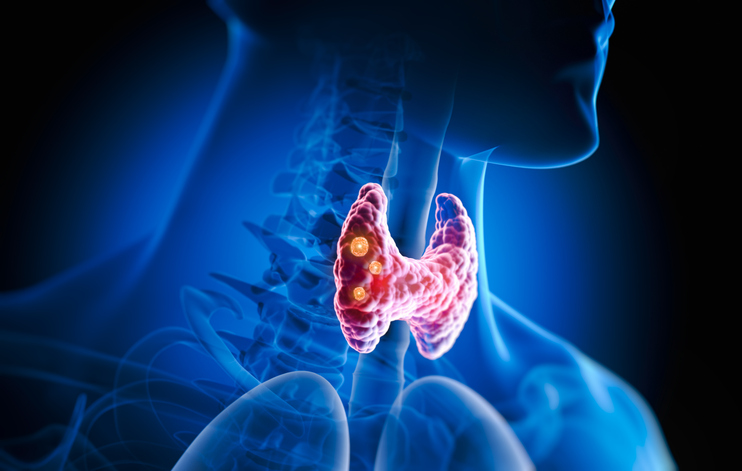
Thyroid problems are the next most common feature of brain-lung-thyroid syndrome. The thyroid gland makes hormones that help regulate a wide variety of critical body functions, including growth, brain development, and the rate of chemical reactions in the body (metabolism). Many affected individuals have reduced thyroid function from birth (congenital hypothyroidism), resulting in lower-than-normal levels of thyroid hormones. Others have a milder condition called compensated or subclinical hypothyroidism, in which thyroid hormone levels are within the normal range, even though the thyroid is not functioning properly. While most people with brain-lung-thyroid syndrome have a normal-sized thyroid, the gland is reduced in size (hypoplastic) or absent (aplastic) in some affected individuals. Although a shortage of thyroid hormones can cause intellectual disability and other neurological problems, it is unclear whether such issues in individuals with brain-lung-thyroid syndrome are due to hypothyroidism or to the brain abnormalities related to the condition.
Lung problems are common in brain-lung-thyroid syndrome. Some affected newborns have respiratory distress syndrome, which causes extreme difficulty breathing and can be life-threatening. Other affected individuals develop widespread lung damage (interstitial lung disease) or scarring in the lungs (pulmonary fibrosis), both of which can also lead to breathing problems. Recurrent lung infections, which can be life-threatening, also occur in people with brain-lung-thyroid syndrome. People with brain-lung-thyroid syndrome have a higher risk of developing lung cancer than do people in the general population.
Padrões de herança
The source lists the following possible inheritance patterns: Autosomal dominant. More than one pattern can apply in different cases.
Related genes
Other names
BLT syndrome
Brain-thyroid-lung syndrome
CAHTP
Choreoathetosis, hypothyroidism, and neonatal respiratory distress
Chreoathetosis and congenital hypothyroidism with or without pulmonary dysfunction
Related patient information and medicines
Patient information leaflet
Testes de função da tireoide
Thyroid function tests are blood tests which help to check the function of your glândula tireoide. They are mainly used to detect an underactive thyroid gland (hypothyroidism) and an overactive thyroid gland (hyperthyroidism). Lots of basic informati... What is a thyroid function test. A thyroid function test is a blood test measuring the levels of.
Patient information leaflet
Glândula tireoide hipoativa
If you have an underactive thyroid gland, the condition is called hypothyroidism. In hypothyroidism, there is a reduced level of thyroid hormone in the body. Treatment usually involves taking a daily tablet of thyroid hormone to replace the missing thyroxine. Treatment works very well for most people with hypothyroidism but is required for life..

Patient information leaflet
Problemas de tireoide e paratireoide
This leaflet gives a brief overview of the thyroid and parathyroid glands and the common medical problems which can occur with these. What are the thyroid and parathyroid glands. Both the thyroid and parathyroid glands are endocrine glands. This means they make and release (secrete) hormones. They act as messengers, affecting cells and tissues in.

Patient information leaflet
Síndrome das pernas inquietas
Síndrome das pernas inquietas causa uncomfortable feelings in your legs. As a result, you have an urge to move your legs which gives temporary relief. What is restless legs syndrome. Restless legs syndrome (RLS) is sometimes called Willis-Ekbom disease after the doctors who first described it. It is a condition where you have an urge to move your legs..

Patient information leaflet
Bócio
A bócio (pronounced goy-ter, sometimes spelt as 'goiter') is an enlarged thyroid gland. This gives you a lump at the front of your neck. Some people with a goitre have an underactive or overactive thyroid gland. This means that they make too much or too little thyroid hormone. There are various causes of goitre and treatment depends on the cause..
Patient information leaflet
Morte ou dano cerebral por anestesia
A risk of dying in the operating theatre debaixo anestesia is extremely small. For a healthy person having planned surgery, around 1 person may die for every 100,000 general anaesthetics given. Brain damage as a result of having an anaesthetic is so rare that the risk has not been put into numbers. When faced with the prospect of having an.
Leitura adicional e referências
- Brain-lung-thyroid syndrome; MedlinePlus, National Library of Medicine.
- Carre A, Szinnai G, Castanet M, Sura-Trueba S, Tron E, Broutin-L'Hermite I, Barat P, Goizet C, Lacombe D, Moutard ML, Raybaud C, Raynaud-Ravni C, Romana S, Ythier H, Leger J, Polak M. Five new TTF1/NKX2.1 mutations in brain-lung-thyroid syndrome: rescue by PAX8 synergism in one case. Hum Mol Genet. 2009 Jun 15;18(12):2266-76. doi: 10.1093/hmg/ddp162. Epub 2009 Mar 31.
- Gras D, Jonard L, Roze E, Chantot-Bastaraud S, Koht J, Motte J, Rodriguez D, Louha M, Caubel I, Kemlin I, Lion-Francois L, Goizet C, Guillot L, Moutard ML, Epaud R, Heron B, Charles P, Tallot M, Camuzat A, Durr A, Polak M, Devos D, Sanlaville D, Vuillaume I, Billette de Villemeur T, Vidailhet M, Doummar D. Benign hereditary chorea: phenotype, prognosis, therapeutic outcome and long term follow-up in a large series with new mutations in the TITF1/NKX2-1 gene. J Neurol Neurosurg Psychiatry. 2012 Oct;83(10):956-62. doi: 10.1136/jnnp-2012-302505. Epub 2012 Jul 24.
- Guillot L, Carre A, Szinnai G, Castanet M, Tron E, Jaubert F, Broutin I, Counil F, Feldmann D, Clement A, Polak M, Epaud R. NKX2-1 mutations leading to surfactant protein promoter dysregulation cause interstitial lung disease in "Brain-Lung-Thyroid Syndrome". Hum Mutat. 2010 Feb;31(2):E1146-62. doi: 10.1002/humu.21183.
- Hamvas A, Deterding RR, Wert SE, White FV, Dishop MK, Alfano DN, Halbower AC, Planer B, Stephan MJ, Uchida DA, Williames LD, Rosenfeld JA, Lebel RR, Young LR, Cole FS, Nogee LM. Heterogeneous pulmonary phenotypes associated with mutations in the thyroid transcription factor gene NKX2-1. Chest. 2013 Sep;144(3):794-804. doi: 10.1378/chest.12-2502.
- Krude H, Schutz B, Biebermann H, von Moers A, Schnabel D, Neitzel H, Tonnies H, Weise D, Lafferty A, Schwarz S, DeFelice M, von Deimling A, van Landeghem F, DiLauro R, Gruters A. Choreoathetosis, hypothyroidism, and pulmonary alterations due to human NKX2-1 haploinsufficiency. J Clin Invest. 2002 Feb;109(4):475-80. doi: 10.1172/JCI14341.
- Nettore IC, Mirra P, Ferrara AM, Sibilio A, Pagliara V, Kay CS, Lorenzoni PJ, Werneck LC, Bruck I, Dos Santos LH, Beguinot F, Salvatore D, Ungaro P, Fenzi G, Scola RH, Macchia PE. Identification and functional characterization of a novel mutation in the NKX2-1 gene: comparison with the data in the literature. Thyroid. 2013 Jun;23(6):675-82. doi: 10.1089/thy.2012.0267.
- Shetty VB, Kiraly-Borri C, Lamont P, Bikker H, Choong CS. NKX2-1 mutations in brain-lung-thyroid syndrome: a case series of four patients. J Pediatr Endocrinol Metab. 2014 Mar;27(3-4):373-8. doi: 10.1515/jpem-2013-0109.
- Williamson S, Kirkpatrick M, Greene S, Goudie D. A novel mutation of NKX2-1 affecting 2 generations with hypothyroidism and choreoathetosis: part of the spectrum of brain-thyroid-lung syndrome. J Child Neurol. 2014 May;29(5):666-9. doi: 10.1177/0883073813518243. Epub 2014 Jan 21.
Compartilhe seus pensamentos ou experiências com outros em nosso comunidades de pacientes.
Acesso simples a tratamentos confiáveis e serviços de saúde online.
Common conditions
Get help with common conditions through the NHS, without a GP appointment.
 Sinusite aguda
 Amigdalite bacteriana
 Impetigo
 Mordidas de insetos
 Herpes zosterInfecção do trato urinário (ITUs)
Inscreva-se no boletim informativo do Patient
Sua dose semanal de conselhos de saúde claros e confiáveis - escritos para ajudá-lo a se sentir informado, confiante e no controle.
Ao se inscrever, você aceita nossos Política de Privacidade. Você pode cancelar a inscrição a qualquer momento. Nunca vendemos seus dados.