Autosomal dominant leukodystrophy with autonomic disease
Última atualização 20 de nov de 2025
Atende aos diretrizes editoriais
- BaixarBaixar
- Compartilhar
- Language
- Discussão
- Ask Patient
- Versão em Áudio
- Adicionar às fontes preferidas no Google
Autosomal dominant leukodystrophy with autonomic disease (ADLD) is one of a group of genetic disorders called leukodystrophies. Leukodystrophies are characterised by abnormalities of the nervous system's white matter, which consists of nerve fibers covered by a fatty substance called myelin. Myelin insulates and protects nerve fibers and promotes the rapid transmission of nerve impulses.
Escolhas de vídeos para Condições genéticasBiblioteca de vídeos
Descrição
Autosomal dominant leukodystrophy with autonomic disease (ADLD) is one of a group of genetic disorders called leukodystrophies. Leukodystrophies are characterised by abnormalities of the nervous system's white matter, which consists of nerve fibers covered by a fatty substance called myelin. Myelin insulates and protects nerve fibers and promotes the rapid transmission of nerve impulses.
People with ADLD develop signs and symptoms of the condition in adulthood, typically in their forties or fifties. The first signs of the condition often involve problems with the autonomic nervous system, which controls involuntary body processes such as the regulation of blood pressure and body temperature. These problems include difficulty with bowel and bladder function, a sharp drop in blood pressure upon standing (orthostatic hypotension), and erectile dysfunction in men. Rarely, people experience an inability to sweat (anhidrosis), which can lead to a dangerously high body temperature.
In ADLD, movement difficulties often develop after the autonomic nervous system problems. Affected individuals can have muscle stiffness (spasticity) or weakness and involuntary rhythmic shaking, called intention tremor because it worsens during movement. People with ADLD often have difficulty coordinating movements (ataxia), including movements that involve judging distance or scale (dysmetria), such as picking up a distant object, and rapidly alternating movements (dysdiadochokinesia), including hand clapping or foot stomping. These movement problems usually first affect the legs, but as the condition worsens, the arms and eventually the face become involved. In some people with ADLD, the symptoms worsen during episodes of fever, infection, or exposure to heat. Due to difficulty walking and an unsteady gait, many affected individuals need a cane, walker, or wheelchair for assistance.
Intelligence is usually unaffected; however, people who have had ADLD for a long time may have a decline in intellectual function (dementia). ADLD worsens slowly, and affected individuals usually survive 10 to 20 years after the onset of symptoms.
Padrões de herança
The source lists the following possible inheritance patterns: Autosomal dominant. More than one pattern can apply in different cases.
Related genes
Other names
ADLD
Adult-onset autosomal dominant leukodystrophy with autonomic symptoms
Autosomal dominant adult-onset demyelinating leukodystrophy
LMNB1-related adult-onset autosomal dominant leukodystrophy
Related patient information and medicines

Patient information leaflet
Doença de Huntington
Doença de Huntington is a genetically inherited condition that causes parts of the brain and nervous system to stop working properly over time. It is a slowly progressive condition that interferes with the movements of your body, thinking and judgement, and can lead to a change in your behaviour. Doença de Huntington is an autosomal dominant.
Patient information leaflet
Cardiomiopatia hipertrófica
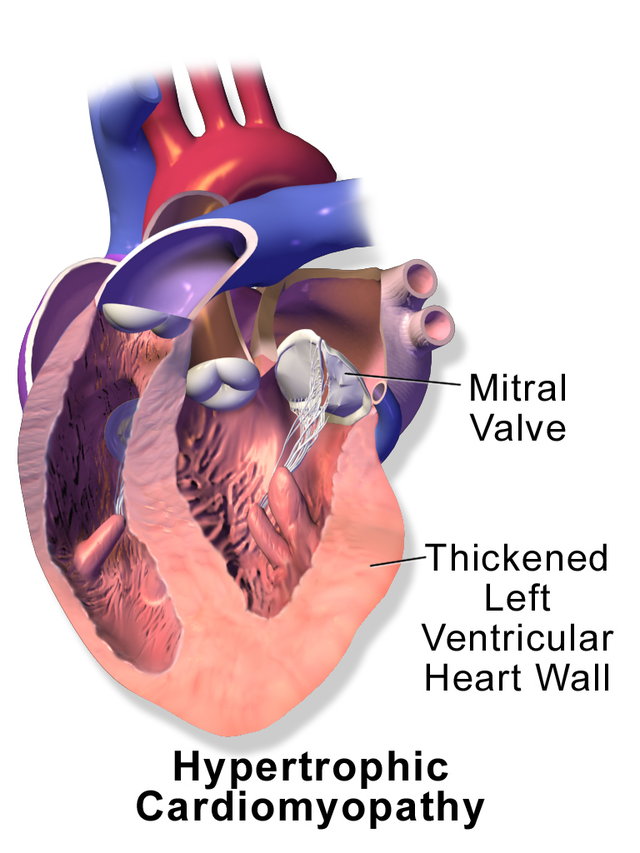
In hypertrophic cardiomyopathy the heart muscle becomes thickened (hypertrophies) in parts of the heart. In the normal heart, the muscle cells are regular and patterned. Genetics In most cases the condition is inherited. If a couple (where one person has HCM) has a child, there is a 1 in 2 chance of the child being affected. This pattern of.

Patient information leaflet
Doença de Wilson
Doença de Wilson é a genetic disorder in which copper builds up in the body, mainly in the liver and brain. Without any treatment, the build-up of copper can cause serious symptoms. How is Wilson's disease inherited. Doença de Wilson é an autosomal recessive disorder. This means that, in order to develop Wilson's disease, two abnormal ATP7B.

Patient information leaflet
Doença de Parkinson
Treatment often provides good relief of symptoms for several... What is Parkinson's disease. Doença de Parkinson is a progressive neurological degeneration of certain cells (called dopaminergic cells) within a specific part of the brain (substantia nigra). The deficiency of dopamine leads to a movement disorder with Parkinson's disease symptoms..

Patient information leaflet
Doença renal policística
Polycystic kidney disease (PKD) causes many fluid-filled sacs (cysts) to develop in the kidneys. The most common type of PKD is an inherited condition called autosomal dominant polycystic kidney disease (ADPKD). With ADPKD, problems commonly do not develop until the age of 30-50, with some people never developing any problems. The two common.

Patient information leaflet
doença de Addison
doença de Addison is a condition in which your glândulas adrenais are not working as well as they should. In Addison's disease the adrenal glands do not produce as much of the steroid hormones (such as cortisol) as they normally do. Treatment is with replacement hormone tablets which you need to take every day. What is Addison's disease. Addison's.
Leitura adicional e referências
- Autosomal dominant leukodystrophy with autonomic disease; MedlinePlus, National Library of Medicine.
- Bartoletti-Stella A, Gasparini L, Giacomini C, Corrado P, Terlizzi R, Giorgio E, Magini P, Seri M, Baruzzi A, Parchi P, Brusco A, Cortelli P, Capellari S. Messenger RNA processing is altered in autosomal dominant leukodystrophy. Hum Mol Genet. 2015 May 15;24(10):2746-56. doi: 10.1093/hmg/ddv034. Epub 2015 Jan 30.
- Ferrera D, Canale C, Marotta R, Mazzaro N, Gritti M, Mazzanti M, Capellari S, Cortelli P, Gasparini L. Lamin B1 overexpression increases nuclear rigidity in autosomal dominant leukodystrophy fibroblasts. FASEB J. 2014 Sep;28(9):3906-18. doi: 10.1096/fj.13-247635. Epub 2014 May 22.
- Finnsson J, Sundblom J, Dahl N, Melberg A, Raininko R. LMNB1-related autosomal-dominant leukodystrophy: Clinical and radiological course. Ann Neurol. 2015 Sep;78(3):412-25. doi: 10.1002/ana.24452. Epub 2015 Jul 27.
- Giorgio E, Robyr D, Spielmann M, Ferrero E, Di Gregorio E, Imperiale D, Vaula G, Stamoulis G, Santoni F, Atzori C, Gasparini L, Ferrera D, Canale C, Guipponi M, Pennacchio LA, Antonarakis SE, Brussino A, Brusco A. A large genomic deletion leads to enhancer adoption by the lamin B1 gene: a second path to autosomal dominant adult-onset demyelinating leukodystrophy (ADLD). Hum Mol Genet. 2015 Jun 1;24(11):3143-54. doi: 10.1093/hmg/ddv065. Epub 2015 Feb 20.
- Giorgio E, Rolyan H, Kropp L, Chakka AB, Yatsenko S, Di Gregorio E, Lacerenza D, Vaula G, Talarico F, Mandich P, Toro C, Pierre EE, Labauge P, Capellari S, Cortelli P, Vairo FP, Miguel D, Stubbolo D, Marques LC, Gahl W, Boespflug-Tanguy O, Melberg A, Hassin-Baer S, Cohen OS, Pjontek R, Grau A, Klopstock T, Fogel B, Meijer I, Rouleau G, Bouchard JP, Ganapathiraju M, Vanderver A, Dahl N, Hobson G, Brusco A, Brussino A, Padiath QS. Analysis of LMNB1 duplications in autosomal dominant leukodystrophy provides insights into duplication mechanisms and allele-specific expression. Hum Mutat. 2013 Aug;34(8):1160-71. doi: 10.1002/humu.22348. Epub 2013 May 28.
- Heng MY, Lin ST, Verret L, Huang Y, Kamiya S, Padiath QS, Tong Y, Palop JJ, Huang EJ, Ptacek LJ, Fu YH. Lamin B1 mediates cell-autonomous neuropathology in a leukodystrophy mouse model. J Clin Invest. 2013 Jun;123(6):2719-29. doi: 10.1172/JCI66737. Epub 2013 May 15.
- Padiath QS, Saigoh K, Schiffmann R, Asahara H, Yamada T, Koeppen A, Hogan K, Ptacek LJ, Fu YH. Lamin B1 duplications cause autosomal dominant leukodystrophy. Nat Genet. 2006 Oct;38(10):1114-23. doi: 10.1038/ng1872. Epub 2006 Sep 3.
- Rolyan H, Tyurina YY, Hernandez M, Amoscato AA, Sparvero LJ, Nmezi BC, Lu Y, Estecio MR, Lin K, Chen J, He RR, Gong P, Rigatti LH, Dupree J, Bayir H, Kagan VE, Casaccia P, Padiath QS. Defects of Lipid Synthesis Are Linked to the Age-Dependent Demyelination Caused by Lamin B1 Overexpression. J Neurosci. 2015 Aug 26;35(34):12002-17. doi: 10.1523/JNEUROSCI.1668-15.2015.
Compartilhe seus pensamentos ou experiências com outros em nosso comunidades de pacientes.
Acesso simples a tratamentos confiáveis e serviços de saúde online.
Common conditions
Get help with common conditions through the NHS, without a GP appointment.
 Sinusite aguda
 Amigdalite bacteriana
 Impetigo
 Mordidas de insetos
 Herpes zosterInfecção do trato urinário (ITUs)
Inscreva-se no boletim informativo do Patient
Sua dose semanal de conselhos de saúde claros e confiáveis - escritos para ajudá-lo a se sentir informado, confiante e no controle.
Ao se inscrever, você aceita nossos Política de Privacidade. Você pode cancelar a inscrição a qualquer momento. Nunca vendemos seus dados.