What is polyphasic or biphasic sleep, and is it good for you?
Peer reviewed by Dr Sarah JarvisAuthored by Danny ChadburnOriginally published 9 Feb 2019
Meets Patient’s editorial guidelines
- DownloadDownload
- Share
- Language
- Discussion
- Audio Version
- Add to preferred sources on Google
We've all done stupid things on New Year's Eve. But could arguing with a friend that I only needed five hours of sleep a night - and that I could prove it - be the dumbest of all?
As someone who'd never really been the best of pals with sleep, changing my habits had been something I'd been mulling over for a while. Even after the heaviest of nights out as a teenager, I'd be up with the larks while my peers dozed until gone noon. And as I grew up, life took its toll and a mobile phone became inseparable from my hand, so that getting to sleep became a lengthy process too.
What are the effects of lack of sleep?
Wouldn't it be frustrating if every time you plugged in your phone, it took 10 minutes before it started to recharge itself? The art of getting to sleep is one that some people struggle with greatly, and it's a self-perpetuating problem as the more you worry about it, the less likely you are to be able to achieve slumber.
That can bring on anxiety, leading to insomnia, and it's been proven that not enough sleep leads to lowered immunity and reduced concentration.
The average person spends around 33 years of their life in bed. 26 of those years are spent sleeping. That statistic is surprising enough, but when you factor in a further seven years of tossing, turning and trying to get to sleep, that's when it really hits home just what a dent it can be on your days on Earth.
What is biphasic sleep?
The vast majority of people operate on a monophasic sleep cycle. Mono means one, so you go to bed at night, wake up in the morning and your sleep for the day is considered complete.
However, some major countries operate a biphasic sleep cycle (bi = two) where sleep is split into separate chunks.
In China, it's a constitutional right for workers to take a break for an hour-long nap after lunch.
In Italy, the riposo is a common practice, with many businesses and public buildings closing for a couple of hours in the early afternoon.
In Spain, the siesta is widely adopted and often accommodates eating and socialising as well as napping.
There's a lot of historical evidence that suggests biphasic sleep used to be the norm around the rest of the world too in the pre-industrial age. References to biphasic sleep, such as 'first and second sleep' have occurred in many forms of literature, with people getting up in the middle of the night to sew, chop wood, read or have sex. The 'waking period' was considered a very fertile time to conceive.
Controlling your body clock
A complete sleep cycle lasts approximately 90 minutes Here you'll go from the lightest stage through the deepest stage of sleep and back again.
If you sleep for 7.5 hours, you'll have gone through five cycles, each with its own characteristics in terms of depth and dreaming. So if you only really get a decent sleep during the first two cycles, are the subsequent 270 minutes a waste of time?
Polyphasic sleep
Further research into this area led me to the practice of polyphasic sleep (poly = many) which is becoming a popular option for many, with a vibrant online community.
This struck a chord with me. I don't work an average 9-5, I can be productive at any hour of the day, and I'm starting a new business venture (deskvillage.com if you're interested) so polyphasic sleep could give me a few extra hours in the day.
As well as biphasic sleep, there are various alternative sleep schedules to select from:
Everyman - one core sleep accompanied by up to three top-up naps.
Dual-core - similar to biphasic sleep, but two periods of core sleep sometimes with an additional nap.
Tri-core - three sleeps of roughly equal duration.
Dymaxion/Uberman/Tesla - extreme methods of four to six 20- to 30-minute naps throughout the day.
The 'everyman' sleep schedule seemed the most suited to me, offering both flexibility and a longish core sleep so the transition wasn't too jarring.
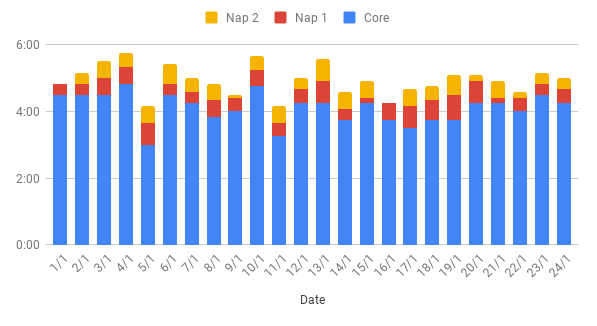
So since 2019 rolled around, I've enjoyed an average of 4h 56m of sleep, broken down into a 4h 05m core sleep and a couple of naps averaging 26 minutes each. Here's how that has developed over the course of the month so far:
Everyman sleep schedule example
The practicalities have taken a bit of getting used to. I've tried sleep tracking apps with inbuilt alarms, automated screen downtime, and even an attempted (an ultimately fruitless) nap-lap around the Circle line. The past few weeks though have taught me that two things are important: flexibility and an eye mask.
Have polyphasic and biphasic sleep schedules made me healthier?
Personally, I'd say yes. Especially in the mental health department. The long hours spent trying to get back to sleep, and all the worry that brings, have disappeared. I have a better relationship with sleep, and I'm more in control of both my day and my body since adopting polyphasic sleeping. I certainly feel healthier knowing I'm going to get five hours of sleep instead of trying (and invariably failing) to get seven.
I discussed my schedule with Professor Adrian Williams of The London Sleep Centre.
How much sleep is enough?
"It's not necessarily about the number of hours you get per night, but the number you get per day." he says. "While being able to function well on anything under seven isn’t within the normally accepted range, everyone operates in a different way. Good sleep reflects itself in better physical well-being and weight regulation, so if you're not showing 'adverse' effects in any of those areas, then there's no reason why it wouldn't be a healthy option.”
We also discussed the various studies that have been done into the subject. For obvious human and animal rights reasons, no controlled observations around sleep deprivation have been conducted in recent years. However, some of the pioneering research into the subject in Russia found that dogs survived longer without water than they did on no sleep, and rats who didn't get adequate amounts of REM became hypersexual.
"Is it then that the siesta, with its association with less REM sleep, is in part responsible for the stereotype of a Latin lothario?" comments Williams.
The nights are spent writing or researching, and a 6am nap means I'm freshly risen for when the kids wake up. The second nap has taken some getting used to (both in terms of switching off and finding a suitable time slot) but as the graph above shows, there's an equilibrium becoming clear.
Can you function on five hours sleep a day?
Well, it's 3:34 am and I've just finished writing and proofreading this article. You be the judge.
Patient picks for Sleep and insomnia
Healthy living
How to fall asleep fast: 5 simple methods for speedy sleep
If you're struggling to sleep, you're not alone. Here are some popular methods to help you unwind and snooze off faster.
by Victoria Raw
Healthy living
CBT for insomnia: how does it work?
If you struggle to sleep at night, it may be that unhelpful thoughts, behaviours, and habits are causing the problem. These can be hard to change on your own - and that's where CBT for insomnia can help. This therapy teaches you how to change the way you think about your sleep problems, which can be the key to solving them.
by Amberley Davis
About the author

Danny Chadburn
Head of Content
Danny was the previous Head of Content at Patient.
About the reviewerView full bio

Dr Sarah Jarvis
Clinical Consultant
MA (Cantab), BM, BCh (Oxon), DRCOG, FRCGP, MBE
After training in medicine at Cambridge and Oxford, Dr Sarah Jarvis MBE became a GP.
Article history
The information on this page is peer reviewed by qualified clinicians.
Article also available in English, German, Spanish, French, Italian, Portuguese, Hindi, Hebrew, Arabic, and Swedish.
9 Feb 2019 | Originally published
Authored by:
Danny Chadburn
Peer reviewed by
Dr Sarah Jarvis
Join the conversation
Share your thoughts or experiences with others in our patient communities.

Ask, share, connect.
Browse discussions, ask questions, and share experiences across hundreds of health topics.

Feeling unwell?
Assess your symptoms online for free
Sign up to the Patient newsletter
Your weekly dose of clear, trustworthy health advice - written to help you feel informed, confident and in control.
By subscribing you accept our Privacy Policy. You can unsubscribe at any time. We never sell your data.
More in healthy living
- Can certain foods mimic the effects of weight loss injections?
- Do you need more sleep in winter?
- NewExercise snacking - how small bursts of movement can boost your mindset
- NewGaynor Faye on Hot Flash, menopause - and why midlife women deserve to be seen
- How does alcohol affect your sex life?
- How peer support can help boost your mental health
- How to get back into exercise after having a baby
- How to improve your self-esteem and be kinder to yourself
- Is bed rotting helping or harming our health?
- Is Christmas music good or bad for your mental health?
- Is getting a sleep divorce the key to better rest?
- Is sleep apnoea dangerous? When snoring issues turn serious
- Is video game addiction real?
- Problems caused by being underweight
- The impact of boredom on our health
- What is forest bathing and can it improve your health?
- Why a Christmas movie can make us feel good
- Why going bald can seriously affect your mental health
- Will making e-cigarettes available on prescription encourage teenagers to smoke?
- NewYoung-onset dementia - what you need to know