Pitiríase versicolor
Revisado por Dr Doug McKechnie, MRCGPÚltima atualização por Dr Philippa Vincent, MRCGPÚltima atualização 26 Fev 2025
Atende aos diretrizes editoriais
- BaixarBaixar
- Compartilhar
- Language
- Discussão
- Versão em Áudio
- Adicionar às fontes preferidas no Google
Profissionais de Saúde
Os artigos de Referência Profissional são projetados para uso por profissionais de saúde. Eles são escritos por médicos do Reino Unido e baseados em evidências de pesquisa, diretrizes do Reino Unido e da Europa. Você pode encontrar o Pitiríase versicolor artigo mais útil, ou um dos nossos outros artigos de saúde.
Neste artigo:
Continue lendo abaixo
What is pityriasis versicolor?
Pityriasis versicolor is a common skin complaint in which mildly scaly, discoloured patches appear mainly on the chest and back. It is sometimes called tinea versicolor, although it is not actually a tinea as this strictly refers to infection with a dermatophyte fungus.
It is caused by the proliferation of the lipophilic fungus of the genus Malassezia (formerly known as Pityrosporum) which is part of the normal flora of human skin.
Usually Malassezia spp. grow sparsely in the seborrhoeic areas (scalp, face and chest) without causing a rash. However the fungus may change from its normal form to a pathological mycelial form.
Pathogenic forms may be triggered by various factors, including humidity and high temperature, hyperhidrosis, familial susceptibility, and immunosuppression. The most common Malassezia species associated with pityriasis versicolor is M. globosa, with M. sympodialis e M. furfur also frequently seen.1
How common is pityriasis versicolor? (Epidemiology)2
Voltar ao conteúdoIt occurs worldwide but is most common in hot and humid climates. It occurs more often in the summer than in the winter months in temperate zones.
Prevalence may be up to 50% in some tropical countries compared with less than 1% in temperate climates.3
It most often affects teenagers and young adults. It is less common in infants and the elderly.
It occurs in people of all skin types but the changes in pigment are more obvious in those with darker skin.3
Most infections occur in normal healthy people but the following factors increase the risk:
Hyperhidrosis or increased physical activity causing sweating.
Occlusive clothes, dressings or ointments.
Immunosuppression or immune deficiency.
Desnutrição.
Continue lendo abaixo
Symptoms of pityriasis versicolor
Voltar ao conteúdoIt usually has an insidious onset and in some cases it can be several months before it is noticed. People often present following a holiday where they have become more tanned and therefore the paler discoloured areas are more apparent.
Macular lesions and patches of altered pigmentation are seen primarily on the trunk.
These lesions frequently spread to the neck, upper arms and abdomen and can sometimes occur at other sites. The rash is usually seen in sebum-rich sites. The face may be affected in some.
There is a superficial scale which is best seen by stretching the affected skin, or scraping the surface.
Pityriasis versicolor close-up
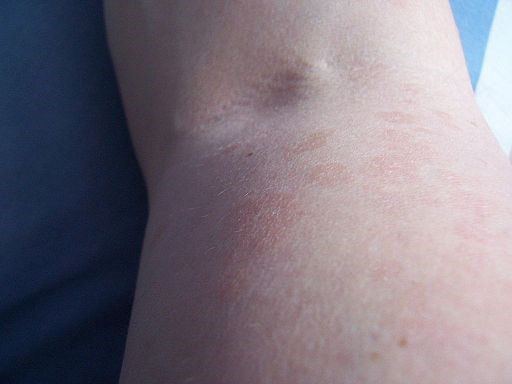
© Richardkiwi at nl.wikipedia (Own work), Public domain, via Wikimedia Commons
Pityriasis versicolor on the forehead
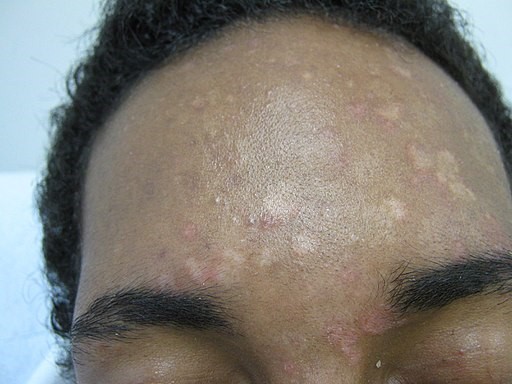
© Grook Da Oger (Own work) CC BY-SA 3.0, via Wikimedia Commons
Sometimes the patches start scaly and brown and then resolve through a non-scaly and white stage.
Itching, if present, is mild.
Pityriasis versicolor is not contagious, as it is a commensal yeast.
Diagnóstico diferencial
Voltar ao conteúdoPityriasis alba.
Dermatite seborreica (may co-exist).
Secundária sífilis.
Continue lendo abaixo
Investigações
Voltar ao conteúdoInvestigations are not usually necessary, as the diagnosis is often made clinically. They may be necessary if the condition is not responding to treatment or if the diagnosis is unclear. Where required, skin scrapings can be sent for microscopy. The spores and hyphae have a 'spaghetti and meatball' appearance on potassium hydroxide wet-mount examination. Yellow to yellow-green fluorescence may be observed on examination of affected areas with a Wood's light. There is no benefit of fungal culture, as the organism is part of the normal flora and isolation is therefore not necessarily relevant.
Treatment for pityriasis versicolor234
Voltar ao conteúdoPityriasis versicolor should be treated initially with topical antifungals, especially topical imidazoles - eg, clotrimazole, miconazole, econazole and ketoconazole in various formulations (creams or shampoos).
Ketoconazole shampoo is usually first-line and should be applied on to affected areas and made into a lather; it should then be left for five to fifteen minutes before washing off. This should be repeated daily for a week and then weekly for a month.56
Selenium shampoo can be used as an alternative although unlicensed for this indication. It should be diluted with water (to reduce the likelihood of irritation), applied to affected areas for ten minutes and then rinsed off. This should be repeated daily for seven to ten days. This is contra-indicated in pregnancy.
If very small areas are involved, or in pregnancy, antifungal imidazole creams such as clotrimazole may be used as an alternative. The cream should be applied twice a day for two to three weeks.
In widespread or resistant cases, prescribe itraconazole 200 mg daily for seven days (although terbinafine is active against dermatophytes (eg, tinea), it actually has little effect on yeast infections). Alternatively, fluconazole may be used - 50 mg daily for two to four weeks, or 300-400 mg weekly for one to three weeks.
Oral treatments should be avoided with a history of heart failure or liver failure. There is a risk of acute liver failure with use of oral antifungal treatments. 7Oral treatments should not be used if pregnant or breastfeeding.
Patients should be advised that it can take several months for the skin colour to return to normal.
Antifungal treatment should be repeated when the scaly component of pityriasis versicolor recurs.
Recurrences of pityriasis versicolor are common.
Profilaxia
For those who are prone to develop recurrent episodes in warm or humid environments, they can be advised to use ketoconazole shampoo prophylactically once a day for three days prior to any exposure.
Ketoconazole or selenium sulfide shampoo may be applied for five to ten minutes one to four times monthly for those who have frequent recurrences.
Complicações
Voltar ao conteúdoInfection often leads to hypopigmentation of the skin, which may persist for months after successful treatment.
Prognóstico
Voltar ao conteúdoPink or brown types of pityriasis versicolor generally clear satisfactorily with treatment but the rash often recurs.
The pale type of pityriasis versicolor also generally clears up with treatment and the skin eventually responds normally to sun exposure.
White marks are occasionally permanent and resistant to antifungal treatment.
Atualizações exclusivas para profissionais de saúde
Mantenha-se informado com as últimas atualizações clínicas, insights profissionais e orientações baseadas em evidências. O boletim informativo Patient Pro seleciona conteúdo essencial para profissionais de saúde—entregue diretamente na sua caixa de entrada.
Ao se inscrever, você aceita nossos Política de Privacidade. Você pode cancelar a inscrição a qualquer momento. Nunca vendemos seus dados.
Leitura adicional e referências
- Pitiríase Versicolor; DermIS (Sistema de Informação em Dermatologia)
- Pitiríase versicolor; DermNet NZ
- Gupta AK, Foley KA; Antifungal Treatment for Pityriasis Versicolor. J Fungi (Basel). 2015 Mar 12;1(1):13-29. doi: 10.3390/jof1010013.
- Pitiríase versicolor; NICE CKS, outubro de 2023 (acesso apenas no Reino Unido)
- Leung AK, Barankin B, Lam JM, et al; Tinea versicolor: an updated review. Drugs Context. 2022 Nov 14;11:2022-9-2. doi: 10.7573/dic.2022-9-2. eCollection 2022.
- Renati S, Cukras A, Bigby M; Pityriasis versicolor. BMJ. 2015 Apr 7;350:h1394. doi: 10.1136/bmj.h1394.
- Formulário Nacional Britânico (BNF); Serviços de Evidências NICE (acesso apenas no Reino Unido)
- Pitiríase Versicolor; Dermnet
- https://bnf.nice.org.uk/drugs/itraconazole/
Continue lendo abaixo
Sobre o autorVer biografia completa

Dr Philippa Vincent, MRCGP
Médico Generalista, Autor Médico
MB BS, Bsc, MRCGP (2000), DCH, DFSRH, DRCOG
Dra Philippa Vincent é um médico do NHS trabalhando no norte de Londres.
Sobre o revisorVer biografia completa

Dr Doug McKechnie, MRCGP
Redator Médico
MA, MBBS, MSc, DRCOG, MRCP(UK), MRCGP(2021), FHEA
O Dr. Doug McKechnie é um médico do NHS que trabalha em Londres. Ele trabalha em tempo integral na prática clínica e também é o Vice-Líder do módulo de Prática Clínica e Profissional na Faculdade de Medicina da University College London.
Histórico do artigo
As informações nesta página são escritas e revisadas por clínicos qualificados.
Próxima revisão prevista para: 25 Fev 2028
26 Fev 2025 | Última versão

Pergunte, compartilhe, conecte-se.
Navegue por discussões, faça perguntas e compartilhe experiências em centenas de tópicos de saúde.

Sentindo-se mal?
Avalie seus sintomas online gratuitamente