Medidor de pico de fluxo para asma
Revisado por Dr Philippa Vincent, MRCGPÚltima atualização por Dr Doug McKechnie, MRCGPÚltima atualização 20 Jan 2025
Atende aos diretrizes editoriais
- BaixarBaixar
- Compartilhar
- Language
- Discussão
- Versão em Áudio
- Adicionar às fontes preferidas no Google
Nesta série:AsmaInaladores para asma
Este folheto fornece informações sobre o medidor de fluxo de pico, utilizado por algumas pessoas com asma.
Em resumo
A peak flow meter measures how fast you can blow air out of your lungs.
It is a small device that your doctor may prescribe if you have asthma.
You need to blow into the device three times, and record the best score.
Peak flow varies by age, size, and sex, and a normal range is found on a chart.
It can help diagnose asthma and monitor how well your asthma treatment is working.
A peak flow diary helps record measurements over time to show patterns.

What is a peak flow meter?
A peak flow meter is a small device that you blow into. It measures the fastest rate of air (airflow) that you can blow out of your lungs. It records airflow in litres per minute(L/min) and provides you with a score, which is called peak expiratory flow rate (PEFR). Your doctor may prescribe a peak flow meter for you if you have asthma. There are different brands of peak flow meter. They all do the same job.
How to use a peak flow meter
Your doctor, nurse or other healthcare professional will show you how to take a peak flow test. It is important to do this correctly; otherwise, the readings can be misleading. Briefly, you must:
Put the marker to zero.
Take a deep breath.
Close your lips around the mouthpiece.
Then blow air out of your lungs as fast as you can into the device. Note the reading. The further reading section has a link to an Asthma UK website which has a video showing how to use a peak flow meter.
When checking your peak flow score, you should do three blows, one after the other. The 'best of three' is the reading to record.
Common mistakes
When you do three blows straight after each other, the readings should all be about the same. If they are not, you may not be blowing into the device correctly.
A common error is to not to blow as hard as you can.
Another common error is to not put your lips right round the mouthpiece to make sure that all the air you blow out goes through the device.
Peak flow meter normal range
Normal peak flow readings vary, depending on your age, size, and sex. The range of normal peak flow readings is published on a chart, and doctors and nurses refer to the chart when they check your peak flow reading.
Knowing your personal best peak flow is also important, and helps you to know what you should expect.
Normally, in healthy people, peak flow readings vary slightly from time to time. The reading is often slightly higher in the evening compared with the morning.
Peak flow graph
What are peak flow meters used for?
To help diagnose asthma
If you have untreated asma:
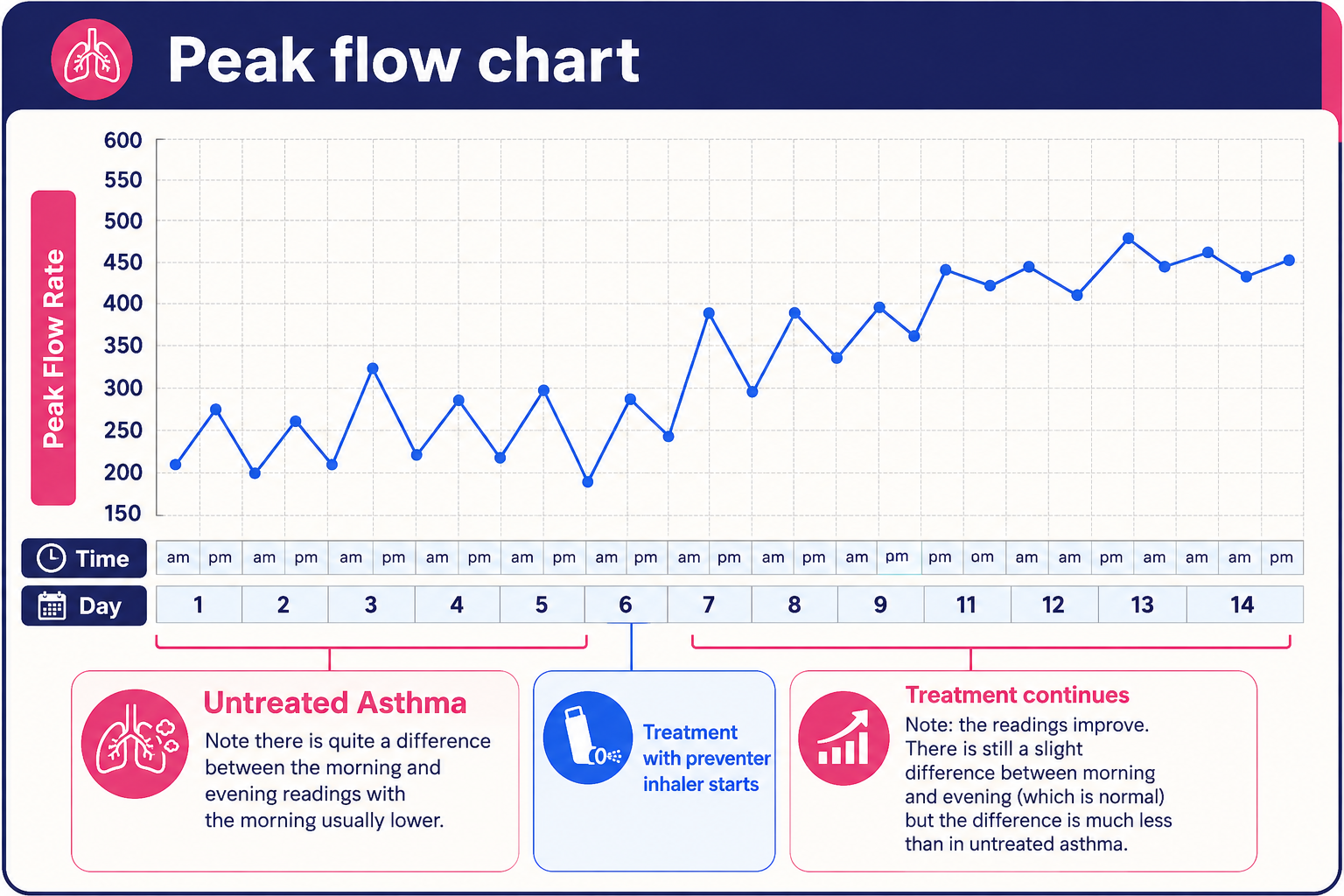
Your peak flow readings will usually be low. No matter how strong you are, if your airways are narrowed, your peak flow will be lower than expected for your age, size, and sex.
Your peak flow readings will tend to vary quite a lot. Typically, the readings are lower in the morning compared with the evening. This difference is much greater in people with untreated asthma than the normal small variation seen in most people.
Sometimes a doctor or nurse will give you a chart (like the one above), and ask you to keep a record of your peak flow readings for a week or so. You will normally be asked to take a 'best of three' peak flow reading each morning and evening. This information can be used to inform your asthma action plan and help doctors make decisions to alleviate asthma symptoms or prevent asthma attacks.
Sometimes a peak flow reading is done before and after you take a dose of asthma medicine to open up your airways. If the treatment causes a large improvement in your reading, this too is typical of asthma.
To monitor treatment
For some people, keeping a peak flow diary can be a good way to monitor how well their asthma is controlled.
This is particularly useful for people who otherwise find it difficult to tell if their asthma is getting worse.
Peak flow meter diary
A peak flow meter diary is a way of recording your peak flow measurements over time. A one-off reading is usually not very useful, but seeing the pattern of how your peak flow measurements change over time can be very helpful.
See the peak flow diary leaflet for an example.
Escolhas do paciente para Asma
Tórax e pulmões
Inaladores para asma
Um inalador é um dispositivo que contém um medicamento que é administrado através da respiração (inalação). Os inaladores são o tratamento principal para asma e ajudam a controlar os sintomas. Existem muitos tipos diferentes de inaladores. Este folheto fornece informações sobre os medicamentos dentro dos inaladores, os tipos de dispositivos inaladores e algumas informações gerais sobre inaladores. Este folheto é apenas sobre inaladores para asma. É importante reconhecer que os mesmos inaladores podem ser usados em outras condições médicas (por exemplo, doença pulmonar obstrutiva crônica), mas a forma como são utilizados pode ser diferente.
por Dr. Doug McKechnie, MRCGP

Tórax e pulmões
Asma
Asthma is a common condition that affects the airways. The typical symptoms are wheeze, cough, chest tightness, and shortness of breath. Symptoms can range from mild to severe. Treatment usually works well to ease and prevent symptoms. Treatment is usually with inhalers. This leaflet gives a general overview of asthma. There are other separate leaflets in this series.
por Dr. Doug McKechnie, MRCGP
Perguntas frequentes
When should I measure my peak flow?
If you are using a peak flow meter to help diagnose asthma, your doctor or nurse will typically ask you to record your 'best of three' peak flow readings each morning and evening for about a week. This helps them understand the pattern of your readings and inform your asthma action plan.
What if my three peak flow blows are not similar?
If you do three blows in a row and the readings are not about the same, it might mean you are not blowing into the device correctly. Common errors include not blowing as hard as you can or not sealing your lips properly around the mouthpiece so that all the air goes through the device.
Why is keeping a peak flow diary useful?
A peak flow diary helps monitor how well your asthma is controlled by tracking your measurements over time. A single reading isn't very informative, but seeing the pattern of changes over days or weeks can be very helpful, especially if you find it hard to tell if your asthma is worsening.
Can a peak flow meter be used to monitor my asthma treatment?
Yes, for some people, regularly recording their peak flow in a diary can be a good way to monitor how effectively their asthma treatment is working and whether their asthma is well-controlled. This is especially helpful if you struggle to recognise when your asthma is getting worse.
How does asthma affect my peak flow readings?
If you have untreated asthma, your peak flow readings will typically be lower than expected for someone of your age, size, and sex, due to narrowed airways. Also, your readings will tend to vary significantly, often being much lower in the morning compared to the evening, more so than the small variations seen in healthy individuals.
Leitura adicional e referências
- Iniciativa Global para Asma (GINA)
- Asma: diagnóstico, monitoramento e manejo da asma crônica (BTS, NICE, SIGN); Diretriz NICE (Novembro de 2024)
- Peak flow; Asthma UK, 2020
Sobre o autorVer biografia completa

Dr Doug McKechnie, MRCGP
Redator Médico
MA, MBBS, MSc, DRCOG, MRCP(UK), MRCGP(2021), FHEA
O Dr. Doug McKechnie é um médico do NHS que trabalha em Londres. Ele trabalha em tempo integral na prática clínica e também é o Vice-Líder do módulo de Prática Clínica e Profissional na Faculdade de Medicina da University College London.
Sobre o revisorVer biografia completa

Dr Philippa Vincent, MRCGP
Médico Generalista, Autor Médico
MB BS, Bsc, MRCGP (2000), DCH, DFSRH, DRCOG
Dra Philippa Vincent é um médico do NHS trabalhando no norte de Londres.
Histórico do artigo
As informações nesta página são escritas e revisadas por clínicos qualificados.
Artigo também disponível em Inglês, Alemão, Espanhol, Francês, Italiano, Português, Hindi, Hebraico, Árabe, e Sueco.
Próxima revisão prevista: 19 Jan 2028
20 Jan 2025 | Última versão

Pergunte, compartilhe, conecte-se.
Navegue por discussões, faça perguntas e compartilhe experiências em centenas de tópicos de saúde.

Sentindo-se mal?
Avalie seus sintomas online gratuitamente
Inscreva-se no boletim informativo do Patient
Sua dose semanal de conselhos de saúde claros e confiáveis - escritos para ajudá-lo a se sentir informado, confiante e no controle.
Ao se inscrever, você aceita nossos Política de Privacidade. Você pode cancelar a inscrição a qualquer momento. Nunca vendemos seus dados.