Costocondrite
Revisado por Dr Toni Hazell, FRCGPÚltima atualização por Dr Surangi Mendis, MRCGPÚltima atualização 5 Ago 2024
Atende aos diretrizes editoriais
- BaixarBaixar
- Compartilhar
- Language
- Discussão
- Versão em Áudio
- Adicionar às fontes preferidas no Google
A costocondrite é uma condição dolorosa na parede torácica, causada por inflamação localizada nas articulações da caixa torácica.
Em resumo
Costocondrite é uma dor na parede torácica causada por inflamação nas articulações entre as costelas e o esterno.
Os sintomas incluem dor aguda e penetrante no peito que piora com o movimento, respiração profunda ou pressão.
A dor geralmente é localizada, mas pode se espalhar e tende a ir e vir.
A maioria dos casos melhora por conta própria em três semanas, e quase todos se resolvem dentro de um ano.
Consulte um médico se tiver outros sintomas além de dor no peito, como febre, tosse ou dificuldade para respirar.
Explore pain relief options
Obtenha aconselhamento especializado em saúde no conforto da sua casa. Faça uma consulta online rápida, disponível 24 horas por dia, 7 dias por semana, e tenha o seu pedido avaliado por um profissional de saúde registado no Reino Unido. Entrega no dia seguinte disponível para tratamentos elegíveis.

What is costochondritis?
Costochondritis is a condition of the chest wall that causes pain. People who get chest pain are often frightened they have a heart or lung problem. Fortunately, if the pain is due to costochondritis, there is no need to panic as it is not a life-threatening condition. Costochondritis usually gets better on its own with time.
The pain of costochondritis comes from the protective ribcage, and not from the heart or lungs or blood vessels inside your chest. More specifically, it comes from one or more of the joints between your ribs and your breastbone (sternum). These joints become inflamed if you have costochondritis.
How does the chest wall work?
Costocondrite
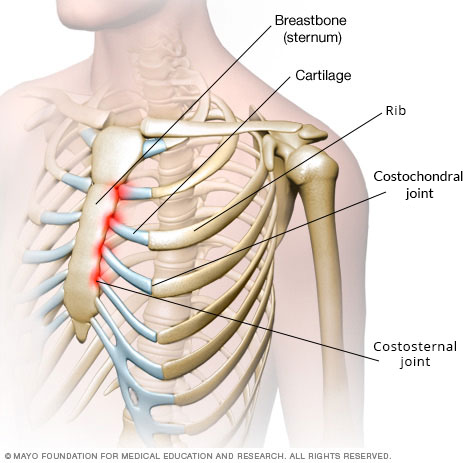
To understand costochondritis, you need to know a bit about the way the rib cage is put together. The rib cage is a bony structure that protects the lungs. Bones are hard and solid and they can't bend or move much. Your lungs, however, need to move, so that you can breathe.
When you take a deep breath in, your rib cage expands (try it! You will feel and see your rib cage moving). In order for the ribs to expand, they need something to allow movement. Cartilage allows this. Cartilage is a softer, flexible (but very strong) material found in joints around the body.
Cartilages attach the ribs to the breastbone (sternum) and the breastbone to the collarbones (clavicles). The joints between the ribs and the cartilages are called the costochondral joints. Those between the cartilages and the breastbone are called costosternal joints. Those between the breastbone and the collarbones are called the sternoclavicular joints.
The prefix 'costo' simply means related to the ribs. 'Chondr-' means related to the cartilage and '-itis' means inflammation. So, in costochondritis, there is inflammation in either the costochondral, costosternal or sternoclavicular joints (or a combination). This causes pain, which tends to be worse when you move, or when you press down on the affected part.
Costochondritis symptoms
Chest pain, felt at the front of the chest.
Typically, it is sharp and stabbing in nature and can be quite severe.
The pain is worse with movement and deep breathing.
Pressure over the affected area can also cause sharp pain.
Some people may feel an aching pain.
The pain is usually confined (localised) to a small area but it can spread (radiate) to a wider area.
The pain tends to wax and wane. It can settle with a change of position and quiet, shallow breathing.
The most common sites of pain are close to the breastbone (sternum), at the level of the 4th, 5th and 6th ribs.
Nota: without tenderness (pain when the chest is pressed), the cause of the chest pain is unlikely to be costochondritis. Remember to seek medical advice if you are unsure of the cause of your symptoms (see the section on 'when to see a doctor').
síndrome de Tietze causes similar symptoms to costochondritis. However, it also tends to cause inchaço at certain tender points on your chest wall. If you have costochondritis, there is nothing to actually see.
Doença de Bornholm is another similar condition but it often leads to muscle aches and pains, as well as chest pain. See the separate leaflet called Bornholm disease for more details.
How common is costochondritis?
It is hard to be sure exactly how common costochondritis is, as lots of people probably have it but don't see a doctor. It seems to be quite common. Of people with chest pain who see their GP, about 1 in 5 have a cause related to the muscles, ribs and joints in their chest wall.
Costochondritis causes
The basic problem is inflammation but the cause of this is unknown for most people. There are some situations that are associated with inflammation and they include:
Chest infections of varying types.
Large physical exertion, like lifting heavy objects or repeated bouts of coughing.
Accidents involving the chest, like falls or car accidents.
Some types of arthritis.
Who develops costochondritis?
There is no particular person more at risk of costochondritis than any other. It does tend to affect younger people, especially teenagers and young adults. It can affect children. People performing repetitive movements that strain the chest wall, particularly if they are not used to it might be more at risk of getting this condition. Some studies suggest women tend to be affected more commonly than men.
People with fibromyalgia tend to develop costochondritis more often than others. Fibromyalgia is a long-term (chronic) condition that causes widespread body pain and fatigue. See the separate leaflet called Fibromyalgia for more details.
Quando devo entrar em contato com um médico?
It can be very difficult to know if your pain is due to costochondritis or whether - and how urgently - to see a doctor. With chest pain, it makes sense to err on the side of caution if you are unsure.
If you feel unwell, breathless, dizzy, or sweaty, or if your chest pain is very severe or spreading to your jaw or left arm then treat it as an emergency. Call 999/112/911 for an emergency ambulance
.
It is more likely that you have costochondritis if:
You are young and otherwise healthy.
You feel generally well in yourself and have no other symptoms.
You have pain which is worse when you move your chest wall or press on it.
The pain is relieved with simple painkillers such as paracetamol or ibuprofen.
If you have other symptoms in addition to the pain then consult a doctor. This would include if you have:
A tosse.
Dificuldade para respirar.
Blood in the mucus you cough up (sputum).
Pain which spreads to other parts of the body.
A rash.
A feeling of having a 'thumping heart' (palpitations).
Also consult your doctor if the pain gets worse as you exert yourself (for example, on walking up a hill) rather than as you twist your chest around. Pain on exertion is more likely to be due to angina.
There is no specific test for costochondritis, but you might be offered other tests to rule out other causes of chest pain.
Costochondritis treatment
Treatment options for costochondritis include:
No treatment. Sometimes it helps just to be reassured there is no serious cause for the chest pain.
Relaxation techniques. Worry can make the pain worse. (Indeed, ansiedade is a common cause of chest pain.)
Simple painkillers such as paracetamol ou ibuprofeno.
Injections of steroids or local anaesthetic medicines if pain is severe and other treatments have not worked.
Non-medicinal measures can be tried for relief of pain in costochondritis. Examples of such techniques include:
Heat pads.
Ice application.
Acupuntura.
Gentle stretching exercises.
Avoidance of sports or activities that worsen the pain.
Physiotherapy or chiropractic therapy to help loosen up the rib cage.
With or without treatment, most people with costochondritis get better gradually over time.
In extreme cases, an intercostal nerve block can be performed (usually by a doctor specialising in pain and/or anaesthetics). This involves injection of a local anaesthetic medicine around the painful ribs.
This blocks the nearby intercostal nerve and temporarily disrupts nerve impulses to stop the pain. Nerve blocks can last several weeks or months. In repeated, severe cases of costochondritis, a series of these injections can be given to permanently calm the nerve causing the pain.
Qual é a perspectiva?
The outlook (prognosis) for costochondritis is generally very good. Most cases of costochondritis are mild and settle reasonably quickly. This happens with or without simple medications.
How long does costochondritis last for?
9 out of 10 people with costochondritis are pain-free after three weeks. In nearly all cases, the condition has completely gone within a year. Occasionally, if you are unlucky, it lasts longer. Costochondritis may return; however, this is unlikely.
Explore pain relief options
Obtenha aconselhamento especializado em saúde no conforto da sua casa. Faça uma consulta online rápida, disponível 24 horas por dia, 7 dias por semana, e tenha o seu pedido avaliado por um profissional de saúde registado no Reino Unido. Entrega no dia seguinte disponível para tratamentos elegíveis.
Escolhas do paciente para Dor no peito

Tórax e pulmões
Dor no peito
Chest pain refers to pain felt anywhere in the chest area from the level of your shoulders to the bottom of your ribs. It is a common symptom. There are many causes of chest pain. This leaflet only deals with the most common. It can often be difficult to diagnose the exact cause of chest pain without carrying out some tests and investigations.
por Dra. Rosalyn Adleman, MRCGP

Tórax e pulmões
Síndrome de dor precordial
Embora a síndrome de dor precordial seja uma causa inofensiva de dor no peito, existem muitas outras causas de dor no peito, algumas das quais são graves e necessitam de atenção médica urgente.
por Dr. Colin Tidy, MRCGP
Perguntas frequentes
A costocondrite pode causar palpitações cardíacas ou um 'coração pulsante'?
Embora a costocondrite em si não esteja diretamente ligada a causar palpitações cardíacas, se você sentir uma sensação de 'coração batendo forte' junto com dor no peito, deve consultar um médico. Este é um dos sintomas que sugere que sua dor no peito pode não ser apenas devido à costocondrite e merece atenção médica.
A costocondrite pode causar ansiedade?
O artigo afirma que a preocupação pode piorar a dor da costocondrite, e a ansiedade é uma causa comum de dor no peito. Isso sugere uma ligação potencial onde a ansiedade pode surgir da dor ou agravá-la, mas não afirma que a costocondrite causa diretamente ansiedade. Se você está experimentando ansiedade significativa, é sempre uma boa ideia discutir isso com seu médico.
A costocondrite pode causar falta de ar?
A própria costocondrite geralmente não causa falta de ar. No entanto, se você sentir dificuldade para respirar além da dor no peito, este é um sintoma que significa que você deve consultar um médico, pois pode indicar uma causa subjacente diferente para a sua dor no peito.
A costocondrite pode causar azia ou indigestão?
A costocondrite é uma inflamação das articulações da caixa torácica e não causa diretamente azia ou indigestão. No entanto, se você sentir azia ou indigestão juntamente com a dor no peito, deve consultar um médico. Esses sintomas adicionais sugerem que outra causa para a sua dor no peito deve ser investigada.
A costocondrite pode fazer você se sentir mal?
O artigo não menciona sentir-se doente como um sintoma direto de costocondrite. Se você estiver sentindo náuseas ou mal-estar geral além da dor no peito, é aconselhável consultar um médico, pois isso pode ser um indicativo de outras condições.
Leitura adicional e referências
- Schumann JA, Sood T, Parente JJ; Costochondritis
- Rokicki W, Rokicki M, Rydel M; What do we know about Tietze's syndrome? Kardiochir Torakochirurgia Pol. 2018 Sep;15(3):180-182. doi: 10.5114/kitp.2018.78443. Epub 2018 Sep 24.
- Mott T, Jones G, Roman K; Costochondritis: Rapid Evidence Review. Am Fam Physician. 2021 Jul 1;104(1):73-78.
- de Carvalho JF; Tietze's Syndrome. Mediterr J Rheumatol. 2022 Dec 31;33(4):467-468. doi: 10.31138/mjr.33.4.467. eCollection 2022 Dec.
Sobre o autor
Atualizado por

Dr Surangi Mendis, MRCGP
Consultor e Autor Médico
MBBS, BSc (1º), MRCGP (2014), DFSRH, PGcert otologia e audiologia
Surangi Mendis é consultora em Medicina Audiovestibular e Neuro-otologia no The Royal National ENT and Eastman Dental Hospitals, UCLH.
Autoria de

Dr Katrina Ford, MRCGP
MB ChB, MRCGP, DRCOG
Sobre o revisorVer biografia completa

Dr Toni Hazell, FRCGP
MBBS, BSc, FRCGP, DFSRH, Dip GU med, DRCOG, DCH (London, UK, 2000)
A Dra. Toni Hazell se formou na Escola de Medicina do Hospital St. Mary e fez seu VTS no Hospital Northwick Park.
Histórico do artigo
Artigo também disponível em Inglês, Alemão, Espanhol, Francês, Italiano, Português, Hindi, Hebraico, Árabe, e Sueco.
Próxima revisão prevista: 4 de agosto de 2027
5 Ago 2024 | Última versão
27 Jan 2011 | Publicado originalmente
Escrito por:
Dr Katrina Ford, MRCGP
Participe da conversa
Compartilhe seus pensamentos ou experiências com outros em nosso comunidades de pacientes.

Pergunte, compartilhe, conecte-se.
Navegue por discussões, faça perguntas e compartilhe experiências em centenas de tópicos de saúde.

Sentindo-se mal?
Avalie seus sintomas online gratuitamente
Inscreva-se no boletim informativo do Patient
Sua dose semanal de conselhos de saúde claros e confiáveis - escritos para ajudá-lo a se sentir informado, confiante e no controle.
Ao se inscrever, você aceita nossos Política de Privacidade. Você pode cancelar a inscrição a qualquer momento. Nunca vendemos seus dados.