Ronco
Revisado por Dr Mohammad Sharif Razai, MRCGPÚltima atualização por Dr Rosalyn Adleman, MRCGPÚltima atualização 29 Dez 2024
Atende aos diretrizes editoriais
- BaixarBaixar
- Compartilhar
- Language
- Discussão
- Versão em Áudio
- Adicionar às fontes preferidas no Google
Nesta série:InsôniaSonambulismoParalisia do sonoComprimidos para dormirBenzodiazepinas e medicamentos Z
Snoring is a noise made as we breathe during our sleep. It may not cause any problems to the person who snores, but it may be so noisy that it disturbs other people sleeping. Sometimes it also interrupts the sleep of the person who snores, making them tired in the daytime.
Many lifestyle factors make snoring more likely, and can be changed. If snoring becomes a problem, there are some treatments which can help. You should consult a doctor about snoring if it is affecting your sleep, making you tired in the daytime, or upsetting other people.
Em resumo
Snoring is caused by vibrations in the soft tissues of your upper airway.
Common causes include being overweight, drinking alcohol, taking sleeping pills, and smoking.
Snoring is usually harmless but can disturb sleep or affect relationships.
See your GP if you wake up gasping, stop breathing during sleep, or feel very tired daily.
Lifestyle changes like losing weight or sleeping on your side can help reduce snoring.
There are various devices available, but not all have strong scientific evidence.
Surgery for snoring is rarely recommended and often not a long-term solution.

What causes snoring?
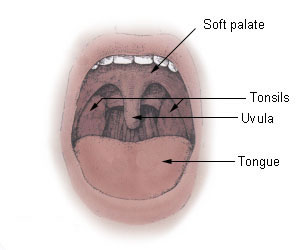
Snoring is due to vibrations in the soft tissues of the upper airway as we breathe. It can happen in any part of the upper airway:
The soft palate. This is the part of the roof of your mouth which is right at the back of your mouth.
The back of your tongue.
The back of your throat. It may involve your tonsils, which are small balls of tissue on either side of the back of your throat. It may involve your uvula, which is the dangly bit of flesh which hangs in the middle of the back of your throat.
A defect in your nose can sometimes cause snoring.
Why do people snore?
Being overweight: this is the number one cause. Too much fat in your neck squashes your throat and causes snoring.
Being drunk! If you've had too much to drink before bedtime, the muscles in your neck relax and make you snore.
Taking sleeping pills can relax you too much and lead to snoring.
Having something wrong with the back of your throat, like a very low soft palate.
Smoking: this can lead to the back of your throat being a bit swollen, causing snoring.
Snoring can happen at any age, to children or adults. It is most common between the ages of 40 and 60. It is more common in men than in women. In children it's usually because their nose is a bit blocked from a cold, or because they have very big tonsils or adenoids; in adults it is more usually some weakness at the back of the throat or being overweight.
Mouth diagram
What problems can snoring cause?
Generally the problem is for the person sleeping next to you.
On a serious note, some people say that snoring has led to the breakdown of their marriage.
Generally, however, snoring isn't harmful for your health.
The only exception is if you literally stop breathing for 5-10 seconds in your sleep. That is something called apneia obstrutiva do sono and can be harmful.
Some people wake themselves up from snoring too loudly and so have a disturbed night, leaving them feeling tired in the morning.
Preciso de algum teste?
If your snoring isn't troubling you or anybody else, you do not need to see a doctor. You should see your GP if:
You wake up gasping in the night regularly (this could indicate something else wrong, like a problem with your heart).
Seu parceiro diz que você para de respirar durante a noite. Se isso acontecer, você pode ter apneia obstrutiva do sono.
You are feeling too tired or sleepy during the day to do the things you need to do, like work or driving safely.
Your snoring is really affecting your partner or your relationship.
Your GP will ask you some questions and examine you. They will want to check your height and weight, and examine your nose, mouth, throat and neck. Usually no tests are needed. If the snoring is really bad they may make a referral to an ear nose and throat doctor.
How to stop snoring
There are lots of remedies and information sites, but not all of the advice works. Here is our guide for things that are generally accepted to work.
Você também pode ler nosso artigo Como parar de roncar e arruinar seu sono para mais dicas e conselhos.
Snoring solutions
Perder peso if you are overweight. You've heard that one before, but getting down to a healthy weight is sometimes all you need to do to stop snoring.
Drink less alcohol, or at least try to go to bed after giving yourself enough time to sober up.
Learn to lie on your side in your sleep. Lying on your back often puts pressure on the back of your throat, causing snoring.
Devices and gadgets
Earplugs: not for you, for your partner.
Nasal dilators. These may be helpful if the snoring noise is mainly coming from your nose. It is a device placed inside the nose before going to sleep to hold the nose open.
Mandibular advancement device. There are a number of splints and shields which are made to push your lower jaw and tongue forward. You put the device in your mouth before going to sleep. It makes more space in the airway and may help if the snoring comes from the base of your tongue. These are more effective if fitted specifically for your mouth by an experienced dentist.
Chin straps. These are straps or bands you put under your chin to hold your mouth closed during the night. This is to force you to breathe through your nose rather than your mouth. This may be helpful if the snoring is coming from your mouth.
Vestibular guard. This is a plastic mouth guard. You put it in your mouth before going to sleep to close off your mouth. This forces you to breathe through your nose. This may be helpful if the snoring is coming from your mouth.
Most of these solutions cannot be prescribed but are available to buy.
Beware: there is not a great deal of scientific evidence behind most snoring treatments you can buy. Be careful not to spend too much - try weight loss and less alcohol first.
Medicamentos
If you have a really bad cold then a short course of a nasal decongestant spray could help. But these should only be used for a few days, otherwise they might damage the inside of your nose.
Operations
Surgery hardly ever helps for snoring, but unfortunately some people get so desperate that they will try anything. Be careful: try to get an opinion from an impartial source first, like an NHS ear, nose and throat surge on, before paying for surgery.
Operations on the nose. If you have pólipos nasais, removing them may stop snoring. If the midline of your nose is crooked (nasal septum deviation) having this straightened may help (but not always).
Tonsillectomy. This is most commonly of benefit for children who snore but it also may be used in adults with large tonsils causing snoring. Usually both tonsils and adenoids are removed. The operation is not done for snoring alone, but may be useful if the large tonsils are causing other problems - for example, apneia obstrutiva do sono or regular bouts of amigdalite.
Uvulopalatopharyngoplasty (UPPP). This is an operation done with a general anaesthetic. Parts of tissue in and around the mouth and throat are removed, creating more space. This includes shortening the strip of tissue that hangs in the middle at the back of your mouth (the uvula) and making incisions in your soft palate at the back of your mouth. It can help snoring, in some cases. Recovery after the operation is often extremely painful.
Laser-assisted uvulopalatoplasty (LAUP). This is a similar procedure to UPPP but done with a laser. The laser burns away the uvula and some of the soft palate.
Radiofrequency ablation of the soft palate. This stiffens the soft palate to stop it vibrating so much. It is done with an injection to numb the roof of the mouth (a local anaesthetic). A device called an electrode is put into the roof of your mouth. Radiofrequency waves are sent into your soft palate through the electrode.
Soft palate implants. These are implants injected into your soft palate, which stiffen it. This should stop it vibrating so much. This is also done with a local anaesthetic.
Many of these surgical techniques have not been formally proven to work for snoring in the long term: although they might provide short-term relief, the snoring usually comes back. That's why some state-funded systems, like the NHS in the UK, no longer fund these snoring treatments.
Escolhas do paciente para Sonho e insônia

Vida saudável
Apneia do sono
Se você tem apneia do sono (também conhecida como síndrome da apneia obstrutiva do sono), você tem muitos períodos em que sua respiração para por 10 segundos ou mais enquanto dorme. Você acorda brevemente após cada episódio de parada respiratória para começar a respirar novamente. Você geralmente não se lembra das vezes em que acorda brevemente, mas tem uma noite de sono perturbada. Como resultado, você se sente sonolento durante o dia. Uma pessoa típica com essa condição é acima do peso, do sexo masculino e de meia-idade, e ronca alto. No entanto, pode afetar qualquer pessoa. O tratamento para apneia do sono geralmente funciona bem.
por Dr. Colin Tidy, MRCGP

Vida saudável
Comprimidos para dormir
Os médicos evitam prescrever comprimidos para dormir, se possível, devido aos problemas que podem causar e à preocupação de que você possa se tornar dependente deles.
por Dr. Colin Tidy, MRCGP
Perguntas frequentes
Can snoring be an inherited trait?
The article mentions that some people might have a very low soft palate, which can cause snoring. This anatomical feature could potentially be inherited, contributing to snoring in families.
Are there any specific exercises or lifestyle changes, other than weight loss and reduced alcohol, that can help strengthen the throat muscles to reduce snoring?
The article primarily focuses on weight loss and reducing alcohol consumption as key lifestyle changes. It also suggests learning to lie on your side. It does not mention specific exercises for strengthening throat muscles.
Are there any risks associated with using nasal decongestant sprays for snoring?
Nasal decongestant sprays should only be used for a few days. Using them for longer periods could potentially damage the inside of your nose.
How effective are operations in providing a long-term solution for snoring?
Many surgical techniques have not been formally proven to work for snoring in the long term. While they might offer short-term relief, the snoring usually returns. This lack of long-term effectiveness is why some state-funded healthcare systems, like the NHS in the UK, no longer fund these snoring treatments.
What is the recovery like after snoring surgery?
For some operations, such as Uvulopalatopharyngoplasty (UPPP), the recovery can be extremely painful.
Leitura adicional e referências
- Ablação por radiofrequência do palato mole para ronco; Orientação sobre Procedimentos Intervencionistas do NICE, janeiro de 2014
- Stuck BA, Hofauer B; O Diagnóstico e Tratamento do Ronco em Adultos. Dtsch Arztebl Int. 29 de novembro de 2019;116(48):817-824. doi: 10.3238/arztebl.2019.0817.
- Ilea A, Timus D, Hopken J, et al; Terapia com aparelho oral na apneia obstrutiva do sono e ronco - revisão sistemática e novas direções de desenvolvimento. Cranio. 2019 Out 5:1-12. doi: 10.1080/08869634.2019.1673285.
- Campos AI, Garcia-Marin LM, Byrne EM, et al; Percepções sobre a etiologia do ronco a partir de investigações observacionais e genéticas no UK Biobank. Nat Commun. 2020 Feb 14;11(1):817. doi: 10.1038/s41467-020-14625-1.
Sobre o autorVer biografia completa

Dra. Rosalyn Adleman, MRCGP
MRCGP
A Dra. Rosalyn Adleman é uma médica do NHS que trabalha no norte de Londres.
Sobre o revisorVer biografia completa

Dr Mohammad Sharif Razai, MRCGP
General Practitioner. Medical Author
BSc, BA, MBBChir, MA (Cantab), MRCGP (2021), FHEA, MA (Distn)
Dr Mohammad Sharif Razai is an award-winning interdisciplinary scientist, clinician and educator. He holds an MA and a Bachelor of Medicine and Surgery from the University of Cambridge, a BSc from University College London and an MA from Birkbeck University of London.
Histórico do artigo
As informações nesta página são escritas e revisadas por clínicos qualificados.
Artigo também disponível em Inglês, Alemão, Espanhol, Francês, Italiano, Português, Hindi, Hebraico, Árabe, e Sueco.
Próxima revisão prevista para: 28 de Dezembro de 2027
29 Dez 2024 | Última versão

Pergunte, compartilhe, conecte-se.
Navegue por discussões, faça perguntas e compartilhe experiências em centenas de tópicos de saúde.

Sentindo-se mal?
Avalie seus sintomas online gratuitamente
Inscreva-se no boletim informativo do Patient
Sua dose semanal de conselhos de saúde claros e confiáveis - escritos para ajudá-lo a se sentir informado, confiante e no controle.
Ao se inscrever, você aceita nossos Política de Privacidade. Você pode cancelar a inscrição a qualquer momento. Nunca vendemos seus dados.