
Hydrocele in adults
Peer reviewed by Dr Toni Hazell, FRCGPLast updated by Dr Philippa Vincent, MRCGPLast updated 4 Sept 2024
Meets Patient’s editorial guidelines
- DownloadDownload
- Share
- Language
- Discussion
- Audio Version
- Add to preferred sources on Google
In this series:Scrotal lumps, pain and swellingTesticular torsionEpididymo-orchitisEpididymal cystVaricoceleHydrocele in infants
A hydrocele is a collection of fluid in the scrotum. Most develop for no apparent reason, are harmless and can be left alone. If needed, surgery can usually cure the hydrocele. In a small number of cases, a hydrocele is due to an underlying problem.
At a glance
A hydrocele is a fluid collection in a sac in the scrotum, next to or surrounding a testicle.
They usually occur on one side, but can affect both testicles.
Most hydroceles are painless, but large ones may cause discomfort.
Medical advice should be sought for any swelling in the scrotum.
An ultrasound scan is normally done to check for any underlying cause.
Treatment options include leaving it alone, draining the fluid, or surgery.
Hydroceles are not usually dangerous, but can occasionally have a serious underlying cause.
What is a hydrocele?
A hydrocele is a collection of fluid in a sac in the scrotum next to or surrounding a testicle (testis). It usually occurs on one side but sometimes a hydrocele forms over both testicles (testes).
Diagram of a hydrocele
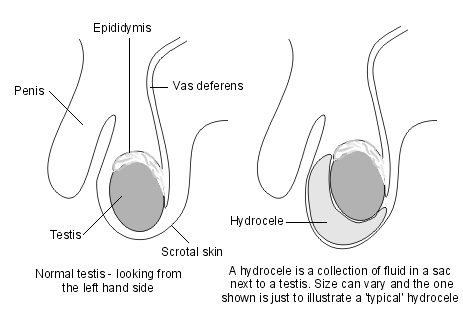
The normal testicle is surrounded by a smooth protective tissue sac. It makes a small amount of 'lubricating' fluid to allow the testis to move freely. Excess fluid normally drains away into the veins in the scrotum. If the balance is altered between the amount of fluid that is made and the amount that is drained, some fluid accumulates as a hydrocele.
The normal scrotum and testes
The scrotum is normally loose, soft and fleshy. It holds the two testicles. A tube (the vas deferens) takes sperm from each testicle to the penis. It is normal for one testis to hang lower than the other.
See the separate leaflet called The male reproductive system.
Hydrocele symptoms
A hydrocele feels like a small fluid-filled balloon inside your scrotum. It feels smooth and is mainly in front of one of the testicles.
Hydroceles vary greatly in size. Very large hydroceles are sometimes seen in elderly men but these have often grown slowly over many years.
Hydroceles are normally painless. Large hydroceles may cause discomfort because of their size. Walking or sexual activity may become uncomfortable with a very large hydrocele.
What is the difference between a hydrocele and a varicocele?
A varicocele is a swelling of the veins surrounding the spermatic cord. It is effectively a varicose vein within the scrotum. It can feel like a little bag of worms but is usually above the testicle.
What causes hydroceles in adults?
Most hydroceles occur in adults and are most common in men aged over 40 years.
The cause is not known in most cases.
Many are due to the processus vaginalis failing to close after birth, allowing fluid to enter the scrotum and surround the testicle. The processus vaginalis normally closes shortly after birth but it remains open for life in about 1 in 5 men. Most boys and men with an open processus vaginalis do not develop a hydrocele but about 1 in 20 do.
A small number of hydroceles are caused when something is wrong with one of the testicles. For example, infection, inflammation, injury or tumours of the testicle may cause fluid to be formed which leads to a hydrocele forming.
Sometimes hydroceles develop when there is generalised swelling of the lower half of the body due to fluid retention.
Are hydroceles common?
Around 1% of men will have a hydrocele.
When to see a doctor about hydroceles
Although most hydroceles are considered primary hydroceles (that is, having no known cause, other than an open processus vaginalis as discussed above), a small number will be due to an underlying cause.
In addition, it can be difficult for a normal person to assess whether the swelling in their scrotum is due to fluid or a different cause.
Therefore, medical advice should always be sought for any swelling in the scrotum. A doctor will usually be able to tell by examination whether it is a hydrocele or a different diagnosis.
Even when they are confident that the swelling is due to a hydrocele they will normally arrange an ultrasound scan to confirm that there is no underlying cause. About 1 in 10 people with a testicular cancer will have a hydrocele associated with this.
How to test for a hydrocele
A doctor will examine the testicles. They may also shine a light through the scrotum, which helps to diagnose a hydrocele.
Usually the clinician will then arrange an ultrasound scan of the testicles. This is to make sure there is no underlying cause for the hydrocele.
What are the treatments for hydrocele?
Leaving it alone
In adults, if the hydrocele causes no symptoms, the usual option is simply to leave it alone. If it becomes larger or troublesome, surgery can be offered.
Surgery
There are two types of surgical intervention which can both be effective.
Aspiration and Sclerotherapy
A needle can be inserted into the fluid and the fluid can be drained through the needle into a syringe. However, the fluid usually re-collects quickly. Sclerotherapy is where a substance is injected into the area to harden it and prevent any further fluid collecting. An antibiotic called doxycycline is the normal sclerosing agent in this case.
The side effects include recurrence of the hydrocele and partial gangrene (death of the tissue of the scrotum). This is only usually used in people who are too frail to have more extensive surgery.
Hydrocelectomy
A hydrocelectomy is a surgical procedure that removes the hydrocele and tries to ensure that it will be less likely to recur. This is usually recommended if the hydrocele is large or uncomfortable. A hydrocelectomy involves making a very small cut in the scrotum. The fluid is then drained from around the testicle (testis). The passage between the abdomen and the scrotum is surgically sealed so the fluid cannot re-form in the future.
This is a minor operation and is performed as a day case, so does not usually involve an overnight stay in the hospital. A hydrocele may return after surgery but this is uncommon. Side effects include haemorrhage, gangrene, pain, infection and reduced fertility.
Are hydroceles dangerous?
Not usually. Occasionally hydroceles have an underlying serious cause such as testicular cancer.
Can you prevent a hydrocele?
Hydroceles are not usually preventable. A few cases are caused by injury to the scrotum so the best way of preventing these is by protecting the scrotum when playing sports such as rugby or cricket.
Patient picks for Testicle and scrotum disorders

Men's health
Blood in semen
Haematospermia means there is blood in the semen. Usually there are no other symptoms such as pain. In men under 40 years old it is usually harmless and resolves without any treatment. However, it can also be caused by a number of conditions that need investigations and treatment.
by Dr Hayley Willacy, FRCGP

Men's health
Epididymal cyst
An epididymal cyst is a harmless fluid-filled growth on a man's testicle (testis). They are quite common and don't usually require treatment. Many men feel them and are concerned that they have testicular cancer, but a doctor can usually tell the difference by examination and/or using an ultrasound scan.
by Dr Colin Tidy, MRCGP
Frequently asked questions
What is considered a large hydrocele?
Hydroceles vary greatly in size. While the article notes that very large hydroceles are sometimes seen in elderly men, it does not specify a particular measurement or definition for what constitutes a 'large' hydrocele. However, it indicates that discomfort, especially during walking or sexual activity, can be a symptom of a very large hydrocele.
Does a hydrocele mean I have cancer?
No, a hydrocele does not mean you have cancer. While about 1 in 10 people with testicular cancer may also have a hydrocele, most hydroceles are considered primary, meaning they have no known underlying cause, such as cancer. However, medical advice should always be sought for any scrotal swelling to rule out serious underlying conditions.
Can hydrocele be treated with antibiotics?
Hydroceles are not directly treated with antibiotics to resolve the fluid collection. However, in a procedure called sclerotherapy, an antibiotic called doxycycline is sometimes injected into the area as a sclerosing agent. This substance helps to harden the tissue and prevent further fluid from collecting after the hydrocele has been drained. This treatment is usually reserved for individuals too frail for more extensive surgery.
Can a hydrocele be drained without surgery?
Yes, a hydrocele can be drained without traditional surgery through a procedure called aspiration. A needle is inserted into the fluid sac, and the fluid is then drained into a syringe. However, the fluid often re-collects quickly after this procedure, unless sclerotherapy (injection of a substance like doxycycline to prevent fluid re-accumulation) is also performed. This approach is typically used for individuals who are not suitable for more extensive surgical options.
Can I live with a hydrocele?
Yes, in adults, if a hydrocele causes no symptoms or discomfort, the usual option is simply to leave it alone. Many hydroceles are painless and do not pose a health risk. Treatment is typically only considered if the hydrocele becomes large, causes discomfort, or if there is an underlying serious cause that needs addressing.
Further reading and references
- Huzaifa M, Moreno MA; Hydrocele. StatPearls, 2020.
- Scrotal pain and swelling; NICE CKS; August 2024 (UK access only)
- Hydrocele; Science Direct
- Dagur G, Gandhi J, Suh Y, et al; Classifying Hydroceles of the Pelvis and Groin: An Overview of Etiology, Secondary Complications, Evaluation, and Management. Curr Urol. 2017 Apr;10(1):1-14. doi: 10.1159/000447145. Epub 2017 Mar 30.
About the authorView full bio
Updated by

Dr Philippa Vincent, MRCGP
General Practitioner, Medical Author
MB BS, Bsc, MRCGP (2000), DCH, DFSRH, DRCOG
Dr Philippa Vincent is an NHS GP working in North London.
About the reviewerView full bio

Dr Toni Hazell, FRCGP
MBBS, BSc, FRCGP, DFSRH, Dip GU med, DRCOG, DCH (London, UK, 2000)
Dr. Toni Hazell qualified from St. Mary’s Hospital Medical School and did her VTS at Northwick Park Hospital.
Join the conversation
Share your thoughts or experiences with others in our patient communities.

Ask, share, connect.
Browse discussions, ask questions, and share experiences across hundreds of health topics.

Feeling unwell?
Assess your symptoms online for free
Sign up to the Patient newsletter
Your weekly dose of clear, trustworthy health advice - written to help you feel informed, confident and in control.
By subscribing you accept our Privacy Policy. You can unsubscribe at any time. We never sell your data.