Coronary artery bypass graft
Peer reviewed by Dr Colin Tidy, MRCGPLast updated by Dr Doug McKechnie, MRCGPLast updated 7 Mar 2025
Meets Patient’s editorial guidelines
- DownloadDownload
- Share
- Language
- Discussion
- Audio Version
- Add to preferred sources on Google
Coronary artery bypass grafting (CABG) is a type of heart surgery to treat coronary artery disease. The standard surgery requires open heart surgery and stopping of the heart temporarily.
At a glance
Coronary artery bypass graft (CABG) is a heart operation for coronary artery disease.
It diverts blood around narrowed or blocked heart arteries.
CABG is considered if medicines don't control angina or after a heart attack.
A coronary angiogram is done before surgery to check your arteries.
Most people are discharged about five days after uncomplicated surgery.
Preventing further heart disease involves lifestyle changes and medicines.
Coronary artery bypass grafting, called CABG for short (pronounced 'cabbage'), is a heart operation. It is also called coronary artery bypass surgery.
A CABG is used to treat coronary artery disease. In coronary artery disease, the arteries supplying the heart become narrowed and blocked, affecting blood flow to the heart. A CABG is an operation which diverts blood around a narrowed or blocked artery.
CABG procedures are a type of major heart surgery. They are usually done in people who have angina that isn't treated well enough with medicines, and in some people who have had a heart attack.
The aim of the surgery is to improve blood flow to the heart. This can improve symptoms of angina, and may reduce the risk of having a heart attack in future. In some cases, this can be life-saving.
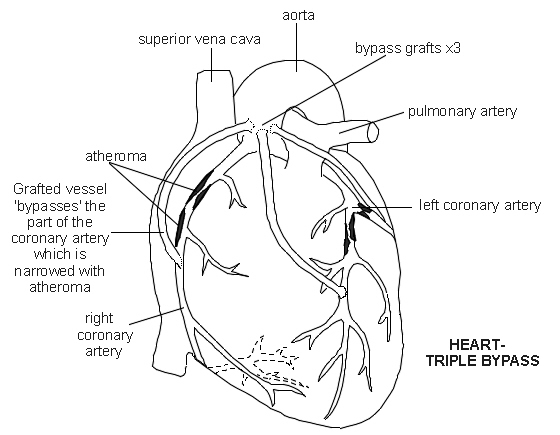
Heart triple bypass
Before a CABG is offered, you will have a coronary angiogram. This is a technique for taking special X-rays. A small tube (catheter) is inserted via your wrist or groin and dye is injected to look at your arteries in greater detail. The procedure is used to look for the location and amount of narrowing in the coronary arteries.
A different procedure - angioplasty and stenting (percutaneous coronary intervention, or PCI) - is usually preferred for treating coronary artery disease because it has fewer risks and a much quicker recovery time.
However, a CABG is recommended in some situations, such as:
If PCI hasn't worked.
If there is a narrowing or blockage in the left main coronary artery - a large artery which provides blood supply to the left side of the heart.
If there is significant narrowing or blockage in several different coronary arteries.
If the left side of the heart is not pumping blood properly.
If someone has diabetes.
Cases are usually discussed at a cardiac multidisciplinary team meeting, which consists of cardiologists, anaesthetists, cardiac nurses and cardiac surgeons. Other illnesses you have and surgical risk will also be discussed and be important in deciding on whether surgery is the right approach.
Some people, particularly people who have had a recent heart attack, may need a hospital stay to wait for urgent surgery.
Coronary artery bypass graft procedure
You will be anaesthetised with a general anaesthetic (fully asleep).
A mid-sternal incision (vertical incision through the breastbone) is made.
The grafts are commonly taken from your leg veins. Sometimes, a graft may be taken from the internal mammary artery, an artery that runs inside the chest.
Most people will need three or more grafts (common terms used are 'triple bypass' and 'quadruple bypass').
During a CABG procedure, your heart and lungs are temporary stopped and the blood bypassed through a heart-lung bypass machine to allow the grafts to be stitched in place:
A technique using a smaller incision has also been used - called minimally invasive direct coronary artery bypass (MIDCAB); however, it is only appropriate for certain cases and is not routinely available.
Operating without bypass is possible but CABG with temporary bypass is the standard.
You will usually need to be on the intensive care unit for 24 hours after the procedure.
You will usually have a chest drain inserted - a tube draining fluid from around the lungs. This will usually be removed 2-3 days later. You will also have a urinary catheter.
People can be ready for discharge after five days provided no complications occur.
Outcome
CABG improves symptoms of angina, quality of life and exercise capacity.
Around 10% of people will need a repeat CABG procedure after 10 years.
The chance of needing repeat surgery can be lessened by controlling the development of heart disease. This means stopping smoking, lowering blood pressure and cholesterol levels and controlling diabetes mellitus.
Complications
Acute kidney injury- kidney problems.
Ventricular arrhythmias - abnormal heart rhythms which can sometimes be serious.
Blood clots developing in the legs (deep vein thrombosis) or lungs (pulmonary embolism).
Stroke occurs in 1-2%. An ultrasound scan of the neck arteries is sometimes done before the operation. In some people with significant 'furring' (plaque disease) of the main neck vessels, carotid artery revascularisation surgery at the same time as a CABG procedure may be performed.
Cognitive decline following CABG surgery has been reported in various studies. Most changes are mild and thought to reverse within the first few months after the operation.
Localised infection at the site of veins taken from the legs.
What follow-up is needed after coronary artery bypass graft?
There will be surgical follow-up after discharge and then ongoing care with your doctor unless there are complications. Most people will be referred on to cardiac rehabilitation.
Prevention of coronary heart disease is very important and will include:
Stopping smoking.
Use of long-term aspirin.
Use of an angiotensin-converting enzyme (ACE) inhibitor or an angiotensin-II receptor antagonist (AIIRA) - also called an angiotensin receptor blocker.
Use of beta-blockers.
Use of statins to achieve target cholesterol levels.
Control of blood pressure and diabetes mellitus.
Exercise and a healthy diet.
Patient picks for General surgery and procedures

Surgery and procedures
Surgical drains
A surgical drain is a small plastic tube that is sometimes used after an operation. It is put inside you during the surgery by the doctor and will stick out of your body until it is removed, usually a few days later. It connects to a small plastic bag that collects any fluid or air that has drained away from where you had the operation. Not all operations require a drain to be in: your surgeon will advise you if one is necessary.
by Dr Rachel Hudson, MRCGP

Surgery and procedures
Vasectomy
Vasectomy is a a form of birth control where a man undergoes a small operation to cut the end of the vas deferens tube. This is the tube that takes sperm from the testicles (testes) to the penis. Sperm are made in the testes. Once the vas deferens is cut, sperm can no longer get into the semen that comes out (is ejaculated) during sexual intercourse. Vasectomy is very reliable - but not quite 100%. Even after a successful operation about 1 in 2,500 men who have had a vasectomy will become fertile again at some point in the future. This is because, rarely, the two ends of the cut vas deferens re-unite over time.
by Dr Philippa Vincent, MRCGP
Frequently asked questions
When is CABG surgery considered over an angioplasty and stenting (PCI)?
A different procedure, angioplasty and stenting (PCI), is usually preferred due to fewer risks and a quicker recovery. However, CABG might be recommended if PCI hasn't worked, if there's a blockage in the left main coronary artery or multiple arteries, if the left side of the heart isn't pumping properly, or if the patient has diabetes.
What happens before a CABG operation is confirmed?
Before surgery is offered, you will have a coronary angiogram to pinpoint blockages. Your case will be discussed by a cardiac multidisciplinary team, including cardiologists and surgeons. They will also consider any other illnesses and your overall surgical risk to decide if CABG is the right approach.
How long is the typical hospital stay after a CABG procedure?
You will usually be in the intensive care unit for 24 hours immediately after the procedure. Most people can be ready to go home after about five days, provided there are no complications during their recovery.
What is involved in the recovery process immediately after CABG?
Immediately after surgery, you'll be in intensive care for 24 hours. You'll likely have a chest drain to remove fluid, which is typically removed after 2-3 days, and a urinary catheter. People can often be discharged after five days if there are no complications.
What does a 'triple bypass' or 'quadruple bypass' mean?
These terms refer to the number of grafts used during the CABG procedure. A 'triple bypass' means three new pathways have been created to bypass blocked arteries, and a 'quadruple bypass' means four. Most people require three or more grafts.
Are there any long-term effects on cognitive function after CABG?
Studies have reported some cognitive decline following CABG surgery. However, most of these changes are mild and are generally thought to reverse within the first few months after the operation.
Further reading and references
- Deb S, Wijeysundera HC, Ko DT, et al; Coronary artery bypass graft surgery vs percutaneous interventions in coronary revascularization: a systematic review. JAMA. 2013 Nov 20;310(19):2086-95. doi: 10.1001/jama.2013.281718.
- Neumann FJ, Sousa-Uva M, Ahlsson A, et al; 2018 ESC/EACTS Guidelines on myocardial revascularization. Eur Heart J. 2019 Jan 7;40(2):87-165. doi: 10.1093/eurheartj/ehy394.
About the authorView full bio
Updated by

Dr Doug McKechnie, MRCGP
Medical Writer
MA, MBBS, MSc, DRCOG, MRCP(UK), MRCGP(2021), FHEA
Dr Doug McKechnie is an NHS GP working in London. He works full-time clinically and is also the Deputy Lead for the Clinical and Professional Practice module at University College London Medical School.
About the reviewerView full bio

Dr Colin Tidy, MRCGP
General Practitioner, Medical Author
MBBS, MRCGP, MRCP (Paediatrics), DCH
Dr Colin Tidy is an NHS Doctor, based in Oxfordshire.
Join the conversation
Share your thoughts or experiences with others in our patient communities.

Ask, share, connect.
Browse discussions, ask questions, and share experiences across hundreds of health topics.

Feeling unwell?
Assess your symptoms online for free
Sign up to the Patient newsletter
Your weekly dose of clear, trustworthy health advice - written to help you feel informed, confident and in control.
By subscribing you accept our Privacy Policy. You can unsubscribe at any time. We never sell your data.