Dissecção aórtica
Revisado por Dr Hayley Willacy, FRCGP Última atualização por Dr Colin Tidy, MRCGPÚltima atualização 13 Nov 2024
Atende aos diretrizes editoriais
- BaixarBaixar
- Compartilhar
- Language
- Discussão
- Versão em Áudio
- Adicionar às fontes preferidas no Google
Nesta série:Aneurisma da aorta abdominalSíndrome de Marfan
An aortic dissection is a rare, serious condition. The inner layer of the aorta (the biggest blood vessel in the body, coming directly from the heart) tears. Blood then surges through the tear. This causes the inner and middle layers of the aorta to separate (dissect).
Aortic dissection is a medical emergency and needs urgent treatment. The treatment for aortic dissection includes an operation to repair the wall of the aorta. Medicines to reduce blood pressure are also used. Aortic dissection is often fatal but early diagnosis and treatment of aortic dissection can greatly improve survival.
Em resumo
An aortic dissection occurs when the inner layer of the aorta, the body's largest blood vessel, tears.
Blood surges through the tear, causing the inner and middle layers of the aorta to separate.
Symptoms include sudden, severe chest pain, often described as tearing, ripping, or shearing.
The pain may spread to the neck or back and can be accompanied by shortness of breath or loss of consciousness.
High blood pressure and certain medical conditions can increase the risk of aortic dissection.
Aortic dissection is a medical emergency requiring immediate treatment, often surgery.
Early diagnosis and treatment significantly improve the chance of survival.
What is the aorta?
The aorta is the largest blood vessel in the body. It is an artery and carries blood from the heart and descends through the chest and the tummy (abdominal aorta).
The part of the aorta that connects with the heart is called the aortic root. The aorta then goes up towards the head (ascending aorta) but then loops (aortic arch) and heads down towards the abdomen (descending aorta).
Many arteries come off the aorta to supply blood to all parts of the body. At about the level of the hips, the aorta divides into two arteries, one going to each leg.
The aorta
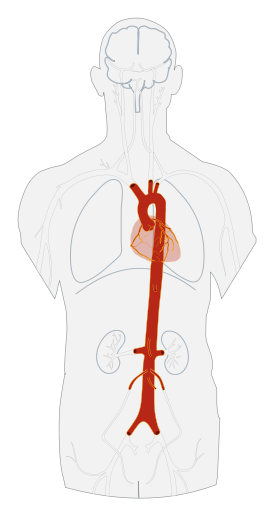
© By Edorado (Own work based on: Arterial System en.svg, Coronary arteries.svg) via Wikimedia Commons
O que é dissecção aórtica?
An aortic dissection occurs in a weakened area of the wall of the aorta. An aortic dissection is a serious condition of sudden onset in which the inner layer of the aorta tears. Blood then surges through the tear, causing the inner and middle layers of the aorta to separate (dissect).
Aortic wall layers
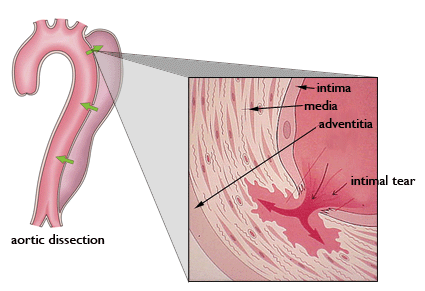
© Image: patient information from the International Registry of Acute Aortic Dissection
Aortic dissections are divided into two groups, depending on which part of the aorta is affected:
Type A aortic dissection
Type A. This involves a tear in the part of the aorta where it exits the heart or a tear in the upper aorta (ascending aorta). The tear may extend into the descending aorta and may extend into the tummy (abdomen).
Type B aortic dissection
Type B. This involves a tear in the lower aorta only (descending aorta). The tear may also extend into the abdomen but any tear that involves the ascending aorta is called a type A aortic dissection.
Aortic dissection symptoms
Aortic dissection may cause:
Estenose dor no peito.
Falta de ar.
The symptoms may be very similar to those of a heart attack.
The chest pain starts suddenly and is often described as a tearing, ripping or shearing feeling.
The pain often spreads to the neck or down the back.
Aortic dissection may also cause loss of consciousness or symptoms similar to a stroke.
There will often be changes in blood pressure and heart rate, with an increased heart rate and low blood pressure.
These may be, for example:
Perda de visão.
Weakness of your legs.
Weakness of one side of your body.
What causes aortic dissection?
Certain conditions make a tear in the wall of the aorta more likely.
Pressão alta over a long period of time may weaken the wall of the aorta, making it more likely to tear.
People who already have an enlarged aorta (aneurisma aórtico) are also at increased risk of aortic dissection.
Some people are born with a condition that causes a weakened wall of the aorta, such as connective tissue disorders. These conditions are uncommon and include Síndrome de Marfan, bicuspid aortic valve and síndrome de Ehlers-Danlos.
There is an increased risk of aortic dissection with regular cocaine or amphetamine use and with any extremely strenuous exercise such as weightlifting.
A severe injury to the chest may also cause aortic dissection.
Estenose aórtica, previous cardiac surgery, having a history of aortic diseases in your family and smoking can also increase the risk.
How is aortic dissection diagnosed?
Initial investigations to diagnose aortic dissection and rule out a heart attack may include:
Testes de sangue.
Um raio-X do tórax.
An ultrasound scan of your heart (echocardiogram, or echo). Either transthoracic or transoesophageal echocardiography may be used.
A computed tomography (CT) scan ou uma ressonância magnética (RM).
What is the treatment for aortic dissection?
An aortic dissection is an emergency and needs immediate treatment. Immediate treatment often involves surgery to repair the damaged aorta.
However, medicines such as beta blockers and nitroprusside may be used before surgery to reduce your heart rate and lower your blood pressure. Using these medicines can help to prevent the aortic dissection from becoming worse and so make surgery more likely to be successful. Surgery for type A aortic dissection may also include replacing the aortic valve of the heart at the same time if this is affected.
After the initial treatment, you may need to take medicine to lower your blood pressure. It is likely that you will remain on this medicine to control your blood pressure for the rest of your life. You may also need regular checks with a specialist doctor, including CT or MRI scans, to monitor the aorta in case any further problems occur.
What are the complications of aortic dissection?
An aortic dissection may cause death due to severe internal bleeding.
Death may also occur as a result of damage to an organ (for example, lesão renal aguda), or as a result of a derrame or damage to the aortic valve of your heart.
Blood may also rupture into the lining around your heart (pericardium) to cause severe pressure on your heart (this is called cardiac tamponade).
Perguntas Frequentes
How common is aortic dissection?
Aortic dissection is relatively uncommon. The condition most frequently occurs in people in their 50s and 60s and is rare in people under 40 years of age. Aortic dissection is more common in men but is still very rare: only about 30 people per million will have one, in a year.
Qual é a perspectiva (prognóstico)?
Aortic dissection is often fatal if the blood-filled channel within the wall of the aorta ruptures through to the outside aortic wall (this is called aortic rupture). However, early diagnosis and treatment of aortic dissection can greatly improve survival.
Can aortic dissection be prevented?
The most effective ways to prevent aortic dissection are to take regular medicine to control blood pressure if you are found to have high blood pressure. You can also reduce your risk by reducing the risk of damage to your heart and arteries. This can be achieved by eating a healthy diet, taking regular exercise, keeping to an ideal body weight and avoiding smoking.
Escolhas do paciente para Blood vessel disorders
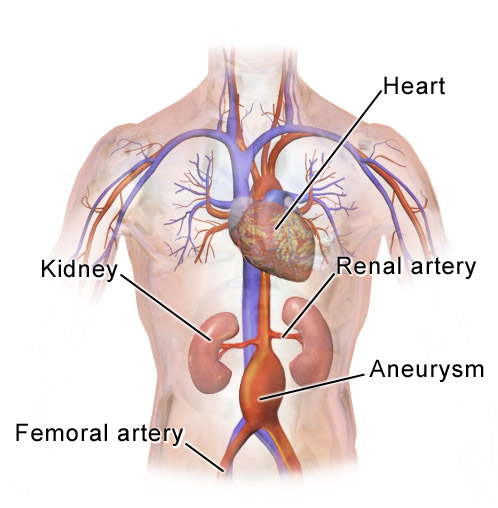
Saúde do coração e vasos sanguíneos
Aneurisma da aorta abdominal
A aorta é o principal vaso sanguíneo no abdômen, descendo do seu coração. Normalmente, tem o diâmetro de uma mangueira de jardim. Em pessoas mais velhas, particularmente aquelas que fumam, parte dela pode aumentar e se expandir. Isso é chamado de aneurisma da aorta abdominal (frequentemente abreviado para AAA, pronunciado 'triple-A'). Isso não causa nenhum sintoma e a pessoa geralmente não sabe que tem, até que vaze ou estoure. O termo médico para isso é ruptura. Se o aneurisma romper, pode ser fatal. No Reino Unido, há um programa de triagem para homens com mais de 65 anos, para verificar se eles têm um triple-A. Uma operação para reparar o aneurisma pode ser aconselhada se ele for maior que 5,5 cm, pois acima desse tamanho o risco de ruptura aumenta significativamente.
por Dr. Doug McKechnie, MRCGP

Saúde do coração e vasos sanguíneos
Espasmo da artéria coronária
Espasmo da artéria coronária é um estreitamento temporário e súbito de uma ou mais artérias coronárias.
por Dra. Hayley Willacy, FRCGP
Perguntas frequentes
What specifically is the internal process of the tear and separation within the aorta?
An aortic dissection begins when the inner layer of the aorta tears. Once this tear occurs, blood surges through it, causing the inner and middle layers of the aorta to separate or "dissect" from each other. This creates a new channel for blood flow within the wall of the aorta itself, rather than flowing purely through the main lumen.
Leitura adicional e referências
- Aneurisma da aorta abdominal: diagnóstico e manejo; Orientação NICE (março de 2020)
- Sayed A, Munir M, Bahbah EI; Dissecção Aórtica: Uma Revisão da Fisiopatologia, Manejo e Avanços Prospectivos. Curr Cardiol Rev. 2021;17(4):e230421186875. doi: 10.2174/1573403X16666201014142930.
- Gawinecka J, Schonrath F, von Eckardstein A; Dissecção aórtica aguda: patogênese, fatores de risco e diagnóstico. Swiss Med Wkly. 25 de agosto de 2017;147:w14489. doi: 10.4414/smw.2017.14489. eCollection 2017.
- Zhou Z, Cecchi AC, Prakash SK, et al; Fatores de Risco para Dissecção da Aorta Torácica. Genes (Basel). 7 de outubro de 2022;13(10):1814. doi: 10.3390/genes13101814.
- Abraha I, Romagnoli C, Montedori A, et al; Enxerto de stent torácico versus cirurgia para aneurisma torácico. Cochrane Database Syst Rev. 2016 Jun 6;(6):CD006796. doi: 10.1002/14651858.CD006796.pub4.
Sobre o autorVer biografia completa

Dr Colin Tidy, MRCGP
Médico Generalista, Autor Médico
MBBS, MRCGP, MRCP (Paediatrics), DCH
Dr Colin Tidy é um médico do NHS, baseado em Oxfordshire.
Sobre o revisorVer biografia completa

Dr Hayley Willacy, FRCGP
Médico Generalista, Autor Médico
MBChB (1992), DRCOG, DFFP, MRCOG (Part 1) MRCGP (2007), DFSRH (2013), MSc - medical education (2020)
A Dra. Hayley Willacy era uma médica do NHS atuando no noroeste da Inglaterra, que se aposentou da prática clínica em 2022 após 30 anos.
Histórico do artigo
As informações nesta página são escritas e revisadas por clínicos qualificados.
Artigo também disponível em Inglês, Alemão, Espanhol, Francês, Italiano, Português, Hindi, Hebraico, Árabe, e Sueco.
Próxima revisão prevista para: 12 Nov 2027
13 Nov 2024 | Última versão

Pergunte, compartilhe, conecte-se.
Navegue por discussões, faça perguntas e compartilhe experiências em centenas de tópicos de saúde.

Sentindo-se mal?
Avalie seus sintomas online gratuitamente
Inscreva-se no boletim informativo do Patient
Sua dose semanal de conselhos de saúde claros e confiáveis - escritos para ajudá-lo a se sentir informado, confiante e no controle.
Ao se inscrever, você aceita nossos Política de Privacidade. Você pode cancelar a inscrição a qualquer momento. Nunca vendemos seus dados.
Mais sobre saúde do coração e vasos sanguíneos
- Aneurisma da aorta abdominal
- Ritmos cardíacos anormais
- inibidores da ECA
- Síndrome coronariana aguda
- Bloqueadores alfa
- Eletrocardiograma ambulatorial
- Estenose aórtica
- Bloqueadores dos canais de cálcio
- Cateterismo cardíaco
- Enzimas cardíacas
- Avaliação do risco de saúde cardiovascular
- Insuficiência cardíaca congestiva
- Cardiomiopatia dilatada
- Hipercolesterolemia familiar
- Pressão arterial baixa
- Medicação com nitratos
- Doença arterial periférica
- Síndrome de taquicardia postural
- Embolia pulmonar
- Veias varicosas