Broken toe
Peer reviewed by Dr Hayley Willacy, FRCGP Last updated by Dr Toni Hazell, FRCGPLast updated 25 Jun 2024
Meets Patient’s editorial guidelines
- DownloadDownload
- Share
- Language
- Discussion
- Audio Version
- Add to preferred sources on Google
A broken (fractured) toe is a fairly common injury which usually needs no specific treatment. It is most often caused by dropping a heavy object on to your foot or badly stubbing your toe.
At a glance
A broken toe normally results from an object falling on it or stubbing it hard.
Common symptoms are pain, swelling, and bruising.
For smaller toes, you can often treat a broken toe at home with rest, ice, elevation, and 'buddy strapping'.
See a doctor immediately if your toe is numb, blue, very cold, bent at an angle, or has an open wound.
Treatment for a broken big toe may involve a walking cast or surgery, and healing can take 6-8 weeks.
Causes of a broken toe
A broken (fractured) toe is an injury normally caused by either dropping a heavy object on the toe or stubbing the toe hard.
Generally it takes quite a lot of force to break a bone. However, toe bones are more vulnerable because they are small bones and because they are on the edge of the body so are more likely to be injured in the first place. A broken little toe, caused by stubbing it, may be particularly common due to its position. A stress fracture is caused by repetitive exercise.
Occasionally, broken toes may occur in association with other complex injuries, such as after a fall from height on to the feet or because of a road traffic accident.
What does a broken toe look like?
Broken toe - marked redness of the third toe
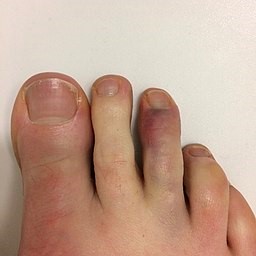
© Dormiraubois, CC BY-SA 4.0, via Wikimedia Commons
Broken toe symptoms
Common symptoms of a broken toe include:
Pain.
Swelling.
Bruising.
Breaking a bone (fracture) is usually a painful injury. Broken bones bleed so the area swells quickly. It eventually bruises as the blood travels through to the skin. Sometimes it is possible to see blood beneath the toenail.
The two ends of the broken bone may be out of line (displaced), or the break may go into the toe joint, in which case the toe might look misshapen. It may be painful to wear shoes
It's painful to walk on a broken toe. This is particularly the case for a broken big toe, as this toe takes more weight when walking.
It can be difficult to be certain that a toe is broken as sprains and strains can also be painful and tender. A misshapen toe usually means a break or dislocation; severe swelling or bruising can be suggestive of a break but often the only way to be sure is with an X-ray. The treatment is generally the same for a break as it is for a sprain, as long as it's not the big toe that has been injured and the toe is not misshapen.
Symptom relief at home
Broken toe treatment depends on which toe has been injured and how badly. If the broken (fractured) toe is not displaced, it is not the big toe and the skin is not broken then a broken toe can often be treated at home.
Rest, ice and elevation are recommended for initial management to help reduce bruising, swelling and pain, and therefore shorten recovery time.
Rest: means not putting excessive weight on the toe and not standing for too long.
Ice: An ice pack (or a pack of frozen peas wrapped in a towel) can be held to the toe for 15-20 minutes every one to two hours for the first couple of days. Beyond 72 hours, ice is no longer beneficial See the separate leaflet called Ice and heat therapy for pain for more information.
Elevation: this means sitting or lying with the foot up, as high as is comfortable. It is helpful for as long as the toe is swollen but particularly for the first 24 hours.
How to wrap a broken toe: for the smaller four toes, a little padding such as gauze, cotton wool or some tissue should be put between the sore toe and the one next to it and then they can be taped together. This is sometimes called buddy taping or buddy strapping. The uninjured toe acts as a splint. The tape should not be too tight and also needs to be removed and fresh tape and padding applied after washing the injured foot.
Pain relief: over-the-counter painkillers such as paracetamol or ibuprofen can be taken to relieve the pain.
Protection: sturdy shoes with stiff soles, that don't squash or bend the toe, should be worn where possible
Normal activity can be resumed once the swelling has gone down and a protective shoe can be worn comfortably.
When to see a doctor for a broken toe
A medical review is not always needed for a broken (fractured) toe. A fractured toe can be managed very safely at home as long as it isn't the big toe, isn't crooked or out of line and there is no skin wound over or near the fracture.
A doctor (or other clinician at, for example, an urgent care centre) should be accessed for a broken toe if:
The pain becomes worse and isn't relieved by normal painkillers.
The swelling and bruising don't start to improve in a few days.
It is advisable to go to an accident and emergency department if:
The toe is numb or tingly. This suggests pressure on, or damage to, the nerves to the toe (which run up the side of the toe, one on each side).
The skin on the toes has turned blue (other than bruising) or grey and is cold to the touch when the other toes are not.
The toe is bent at an angle or with an open wound.
The injured toe is the big toe.
There is more than one fractured toe.
The injured person is a child: children may need a special boot for walking. It can be difficult to be certain that the child's toe is not misaligned without an X-ray.
The accident in which the toe was damaged was severe and there are other potential injuries - for example, a fall from a height or a road traffic accident.
Broken toe treatment
Walking cast
A broken (fractured) big toe may be put in a cast to support it, as it takes much more weight than the other toes and is also needed for balance.
Walking aids
If surgery is not required, crutches may be given in order to reduce weight being put through the broken toe on walking.
Surgery
The big toe is more likely than the smaller toes to need surgery in order to heal properly and to be as strong as it was before it was broken. If surgery is needed this can be done in several ways:
With a metal wire (called a K-wire) which is inserted through the tip of the toe, down its length. K-wires are smooth and slim. They are inserted with a special drilling device, usually under anaesthetic. The wire can be pulled out fairly painlessly by the surgeon once the bones have healed, usually 3-4 weeks later.
With internal wiring or metal plates which can't be seen from the outside and which stay permanently in place.
External fixation with pins and bars may be needed for a complicated broken toe.
Treatment for a badly broken toe
If there is a lot of blood under the nail this may put pressure on the nail and make it very painful. The accident and emergency department may make a small hole in the nail with a heated needle in order to allow the blood to escape or they might remove the nail. However, they will be cautious if there is a break (fracture) beneath the nail as an intact nail will protect the break underneath from infection.
If the skin is broken then antibiotic medication might be needed to prevent an infection in the fracture which would interfere with healing and could spread further into the foot.
If the toe is crooked, particularly if the fracture is through one of the toe joints, the toe may need to be put back into line and held with metal pins. Sometimes it may be possible to realign the toe without surgery, by manipulating the toe under a local anaesthetic (using an injection to numb the area).
A plaster cast might then be put over the foot to keep everything firmly in place whilst it all heals. Sometimes crutches or a special boot might be needed.
How long does a broken toe take to heal?
This depends on which toe has been injured and how badly. It will also depend on age, as bones generally take longer to heal as people age. The pain should diminish gradually if the bone is healing properly.
Broken big toe:
2-3 weeks in a walking boot or cast (leaving room for swelling) then
3-4 weeks in a stiff-soled shoe.
Return to work and sport in 6-8 weeks is usual.
Broken lesser toes, including broken pinky toe:
Buddy strapping and use of a stiff-soled shoe.
Walking when bearable.
Usually healed completely within 4-6 weeks.
Complications of a broken toe
Well-healed broken (fractured) toes usually cause no ongoing problems. The possible complications, which are more likely to happen after severe breaks, include:
Failed healing of the bones: this can either mean the bones heal in a crooked state or that they don't heal together at all. In either case further surgery may be needed.
Bone infection: this is called osteomyelitis and can be very persistent. There is a risk of this if the skin over the fractured toe is damaged. A long course of antibiotics or further surgery may be needed.
Toe stiffness is a common consequence of a broken toe, particularly if the joint was involved. Joints anywhere in the body which have had blood in them have a tendency to become stiffer. Physiotherapy exercises may help.
Pain: it is quite common to have occasional aches and pains in a bone that has been broken, particularly after heavy use. More severe pain suggests further treatment is needed.
Arthritis: post-traumatic arthritis can develop after a fracture.
Skin injury from buddy strapping that is too tight or isn't removed when the foot is washed and remains wet.
Patient picks for Fractures

Bones, joints and muscles
Broken or bruised ribs
Broken or bruised ribs occur when there is a force to the chest such as from a fall, road accident or assault. The force from severe coughing, straining, or heavy sports can also cause rib injury. The symptoms may include pain when coughing, laughing or sneezing, and swelling around the ribs. A bruised rib usually heals itself in 2-3 weeks; pain killers may help with the symptoms. Complications can occur if internal organs are damaged by the sharp end of a broken rib. If you are feeling breathless or unable to catch your breath - call for an emergency ambulance immediately (999 in the UK).
by Dr Philippa Vincent, MRCGP
Bones, joints and muscles
Pelvic fractures
The pelvis is a ring of bone at hip level, made up of several separate bones. A fracture in the pelvis is a break in any one of those bones. A pelvic fracture usually involves more than one break; this is because of the shape of the pelvis - it is impossible to make one break in a circle. Sometimes a small crack on the edge of a pelvic bone can occur alone.
by Dr Toni Hazell, FRCGP
Frequently asked questions
Can I put weight on a broken toe?
You should rest and avoid putting excessive weight on the injured toe. Normal activity can be resumed gradually once the swelling has reduced and you can comfortably wear a protective shoe. If it's a broken big toe, you may need a walking boot or cast, and crutches might be recommended to minimise weight-bearing.
When can I return to work or sports after a broken toe?
For a broken big toe, it's usually possible to return to work and sports in 6-8 weeks. For smaller toes, which are usually healed within 4-6 weeks with buddy strapping and stiff-soled shoes, you can resume normal activity once the swelling is down and you can comfortably wear a protective shoe.
What kind of shoes should I wear if I have a broken toe?
You should wear sturdy shoes with stiff soles that do not squash or bend your toe. This helps protect the injured toe and prevents further discomfort or damage during the healing process.
What should I do if blood collects under my toenail after an injury?
If there is a lot of blood under the nail, it can cause significant pain due to pressure. An accident and emergency department may address this by making a small hole in the nail to release the blood or, in some cases, remove the nail. However, they are cautious if there's a fracture underneath, as an intact nail offers protection from infection.
What are the common complications of a broken toe?
While most well-healed broken toes cause no ongoing problems, potential complications, especially with severe breaks, include the bones not healing correctly (either crookedly or not at all), bone infection (osteomyelitis) if the skin is damaged, and toe stiffness, especially if a joint was involved. You might also experience occasional pain or, in some cases, develop post-traumatic arthritis. Skin injury can also occur from buddy strapping if it's too tight or not kept clean.
Further reading and references
- Beck M, Wichelhaus A, Rotter R, et al; [Metatarsal and toe fractures]. Unfallchirurg. 2019 Apr;122(4):309-322. doi: 10.1007/s00113-019-0620-1.
- Mohamed MB, Paulsingh CN, Ahmed TH, et al; A Systematic Review and Meta-Analysis of the Efficacy of Buddy Taping Versus Reduction and Casting for Non-operative Management of Closed Fifth Metacarpal Neck Fractures. Cureus. 2022 Aug 26;14(8):e28437. doi: 10.7759/cureus.28437. eCollection 2022 Aug.
About the authorView full bio

Dr Mary Elisabeth Lowth, FRCGP
MA (Cantab), MB, BChir, DFFP, DRCOG, PG Cert, Med Ed, FRCGP, MA (London)
Dr Mary Lowth was a Suffolk GP for 20 years, specialising in paediatrics and child protection, and later in documentation of torture.
About the reviewerView full bio

Dr Hayley Willacy, FRCGP
General Practitioner, Medical Author
MBChB (1992), DRCOG, DFFP, MRCOG (Part 1) MRCGP (2007), DFSRH (2013), MSc - medical education (2020)
Dr Hayley Willacy was an NHS GP working in northwest England, who retired from clinical practice in 2022 after 30 years.
Article history
Article also available in English, German, Spanish, French, Italian, Portuguese, Hindi, Hebrew, Arabic, and Swedish.
Next review due: 4 Jun 2027
25 Jun 2024 | Latest version
23 Apr 2015 | Originally published
Authored by:
Dr Mary Elisabeth Lowth, FRCGP
Join the conversation
Share your thoughts or experiences with others in our patient communities.

Ask, share, connect.
Browse discussions, ask questions, and share experiences across hundreds of health topics.

Feeling unwell?
Assess your symptoms online for free
Sign up to the Patient newsletter
Your weekly dose of clear, trustworthy health advice - written to help you feel informed, confident and in control.
By subscribing you accept our Privacy Policy. You can unsubscribe at any time. We never sell your data.
More in bones, joints and muscles
- Broken or bruised ribs
- Compartment syndrome
- Disease-modifying antirheumatic drugs
- Greater trochanteric pain syndrome
- Groin strain
- Guillain-Barré syndrome
- Hip fracture
- Hip replacement
- Joint pain
- Multiple sclerosis
- Myasthenia gravis
- Olecranon bursitis
- Reactive arthritis
- Rhabdomyosarcoma
- Rheumatoid arthritis
- Shoulder pain
- Slipped disc
- Temporomandibular Joint Disorder (TMD)
- Thoracic back pain
- Whiplash neck sprain