
What is the planetary health diet?
Peer reviewed by Dr Krishna Vakharia, MRCGPLast updated by Amberley DavisLast updated 6 Jun 2024
Meets Patient’s editorial guidelines
- DownloadDownload
- Share
- Language
- Discussion
- Audio Version
- Add to preferred sources on Google
What you eat doesn't just influence your own health. It can also be the key to keeping the planet healthy and to ensuring that nutritious food gets to more people in the world experiencing hunger and malnutrition. These are the goals of the planetary health diet.
What is the planetary health diet?
The planetary health diet has been drawn up by scientists to help us eat in a way that's good for both people and planet. The result of three years' work by the EAT-Lancet Commission, this diet is based on the principle that food is a crucial link between human health and environmental health.
The scientists who devised the planetary health diet believe that if enough people adopt it, not only will these individuals benefit from its nutrition, but the food supply chain will eventually adapt to become a more sustainable system - one that improves access to nutritious food in the parts of the world that need it.
The role of food production and its inefficiencies was given high priority in COP28 - the United Nations Framework Convention on Climate Change - in November 20231. Global leaders and experts are now recognising that the food we eat, how we produce it, and how much we waste has significant consequences for people and planet.
What can you eat on the planetary health diet?
Plate portion sizes
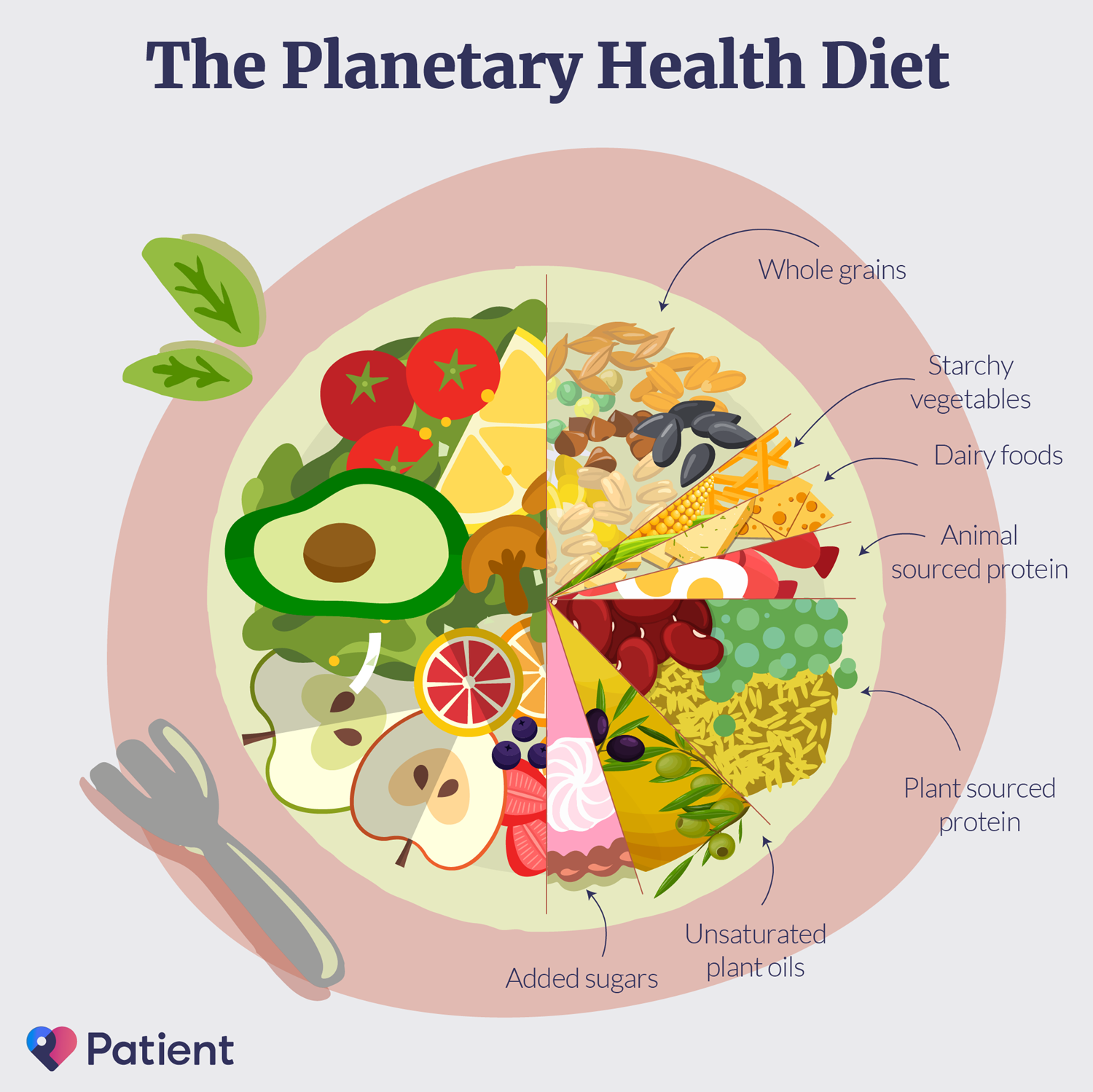
The hallmarks of the planetary health diet2:
Eat mostly plant-based foods - vegetables, fruits, whole grains, nuts, and legumes make up the biggest proportion.
Eat meat and dairy in moderation - if you eat these products, you can still eat them but in significantly smaller amounts.
Eat in multi-colour - this encourages you to consume wide a variety of different fruit and vegetables.
Focus on unsaturated rather than saturated fats - the latter should be eaten in moderation3.
Eat less refined grains, highly processed foods, starchy vegetables, and added sugars.
So that anyone can follow the planetary health diet, it allows for a large amount of flexibility. This gives you room to tailor your personal planetary diet to suit your own tastes, geographical location, and culinary traditions. In this sense, this diet can be described as a type of flexitarian diet.
The planetary health diet report also emphasises the importance of appropriate portion sizes. As a guide, they suggest the average adult requires 2500kcal per day, but acknowledge that this will vary depending on gender, age, and how active you are.
Benefits of the planetary health diet
This isn't the first time scientists have recognised the human and planetary health benefits of diets that are mostly or wholly plant-based. The World Wildlife Fund’s (WWF) plant-based diet guide also places emphasis on "eating planet-based".
This is because evidence shows that eating plant-based can:
1. Reduce the carbon footprint of food production
The food production industry accounts for 70% of global freshwater use and up to 30% of global greenhouse gas emissions4. The land used for food production is also the biggest cause of wildlife loss. To make matters worse, more than one third of this food is lost as food waste5.
But food from animals - especially red meat - has the highest carbon footprint per serving out of all the food groups. According to the WWF, a plant-based diet can reduce6:
Wildlife loss by up to 46%.
Food production greenhouse gas emissions by at least 30%.
Land lost to agriculture by at least 41%.
2. Improve public health
The EAT-Lancet Commission proposes that shifting from unhealthy diets to the planetary health diet could prevent 11 million premature adult deaths each year4.
This sustainable diet also limits your intake of sugar, refined carbohydrates, saturated fats and trans fats, which in high quantities can raise cholesterol and increase your risk of problems such as obesity, heart disease, and type 2 diabetes.
By addressing over-consumption in some parts of the world, this diet also aims to increase access to nutritious food groups in other parts where malnutrition and hunger are rife. Over 820 million people go hungry every day4, but a sustainable diet can drive demand for the right foods back through the food supply chain.
Limitations of the planetary health diet
There have been some criticisms and questions around the planetary health diet:
Q. Are the proposed portions of animal-source protein too small to allow sufficient intake of vitamin B12, vitamin D, retinol, and calcium?
A. The commission has responded7 that this diet allows for two servings a day and that vitamin B12 may need to be supplemented. It's also worth noting that the same advice extends to plant-based diets and these are still considered healthy.
Q. Will the lower amounts of fish and higher amounts of plant oils create an unhealthy balance of omega 3 and omega 6?
A. The commission cites that they have used the most trusted available evidence on human diets. However, they acknowledge that there are general knowledge gaps in research, in part due to it not always being possible trial diets for a long period of time, due to ethical and safety standards.
Does the planetary health diet work for weight loss?
Although not a weight loss diet in the traditional sense, healthy weight loss does form part of the planet-human health equation. The idea being that, generally speaking, it can help people carrying excess weight to lose it, while improving access to foods for those who are malnourished.
In the parts of the world where overweight and obesity are common, like the US and UK, this diet offers an alternative to the ultra-processed, fatty, and sugary Western diet traditions. At its heart, the planetary health diet is about eating healthily and limiting excess - emphasising portion size control, prioritising fruit and veg, watching meat and dairy intake, and limiting processed meals.
End goal
Ultimately, this nutritious and sustainable diet has been designed with one significant end goal - to transform our global food system into a completely sustainable model by 2050, securing healthy food for everyone on Earth while drastically reducing its environmental impact.
The more people who take up the planetary health diet, the closer we come to this shared goal.
Further reading
Patient picks for Diet

Diet and nutrition
What is the Nordic diet?
The Nordic diet originates from the traditional eating habits of regions in northern Europe and the North Atlantic. These colder countries share a dietary approach of locally grown plant-based foods and responsibly sourced game meats. It’s sometimes called the Scandinavian diet, but whichever name you know it by, let's take a look at what it involves, along with its potential health benefits.
by Victoria Raw

Diet and nutrition
Biblical eating - a nutritionist's take on the latest food trend
What is biblical eating, where does it come from, why is it becoming popular, and is it another fad? Read on to find out what biblical eating really means and what a nutritionist makes of the trend.
by Helena Barham-Coppola
About the authorView full bio
Updated by

Amberley Davis
Senior writer
BA (Hons), CPD
Amberley is a senior writer with Patient and has written extensively on a range of health and wellbeing topics.
Authored by
Amberley Davis
Senior writer
BA (Hons), CPD
Amberley is a senior writer with Patient and has written extensively on a range of health and wellbeing topics.
About the reviewerView full bio

Dr Krishna Vakharia, MRCGP
Chief Medical Officer for Health, Optum UK
MBChB, MRCGP(2013), BMedSci (hons), DFSRH, DRCOG, PGDipDerm (Distn)
Dr Krishna Vakharia is an NHS GP. She is also a regular examiner for the postgraduate Diploma in Practical Dermatology at Cardiff University as well as being the Chief Medical Officer for health at Optum UK.
Article history
Article also available in English, German, Spanish, French, Italian, Portuguese, Hindi, Hebrew, Arabic, and Swedish.
Next review due: 6 Jun 2027
6 Jun 2024 | Latest version
27 Jan 2023 | Originally published
Authored by:
Amberley Davis
Join the conversation
Share your thoughts or experiences with others in our patient communities.

Ask, share, connect.
Browse discussions, ask questions, and share experiences across hundreds of health topics.

Feeling unwell?
Assess your symptoms online for free
Sign up to the Patient newsletter
Your weekly dose of clear, trustworthy health advice - written to help you feel informed, confident and in control.
By subscribing you accept our Privacy Policy. You can unsubscribe at any time. We never sell your data.