
What are the best exercises for osteoporosis?
Peer reviewed by Dr Sarah JarvisLast updated by Abi MillarLast updated 26 Jan 2018
Meets Patient’s editorial guidelines
- DownloadDownload
- Share
- Language
- Discussion
- Audio Version
- Add to preferred sources on Google
The issue of exercising with osteoporosis can doubtless be complicated. While, on one hand, physical activity is good for strengthening bones, certain exercises may place some people at risk of a fracture. As a result, confusion tends to abound - how much exercise should people with osteoporosis be doing and what types are safe?
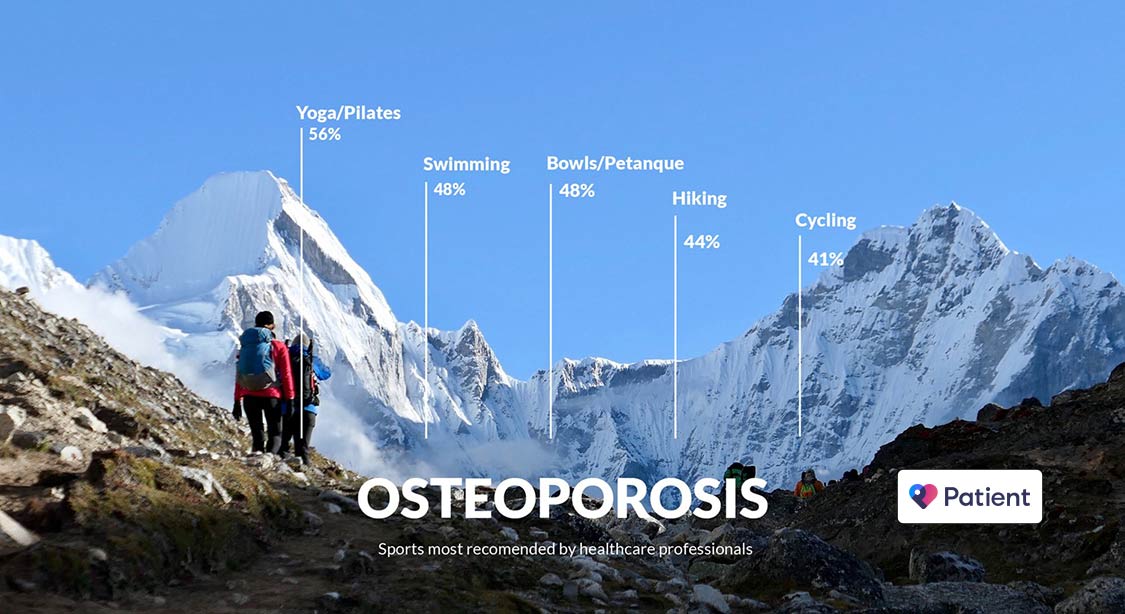
In Patient’s recent survey of 281 healthcare professionals, doctors typically favoured lower-impact exercises: yoga/Pilates (recommended by 57% of doctors), bowls/pétanque (recommended by 49%) and swimming (49%). The least recommended activities were skiing/snowboarding (7%), skateboarding/rollerblading (6%) and rugby (3%) - all sports with a high risk of collisions or falls.
Osteoporosis Nurse Consultant Sarah Leyland, of the National Osteoporosis Society, thinks our respondents may be playing it safe - recommending the sports with the lowest risk of fracture, rather than necessarily the ones most likely to improve bone health.
"At the moment, I think people feel that if they get a diagnosis of osteoporosis they have to stop doing things, but there are no absolute dos and don’ts," she says. "If you are breaking bones very easily, you need to be aware of the risks involved, but I think many people with low bone density should continue with their activities as they always have."
We asked healthcare professionals which are the best sports for osteoperosis
Strong, straight and steady
The National Osteoporosis Society is currently working on revising its recommendations on exercising with osteoporosis, with a view to standardising the advice available. Its project, Strong, Straight and Steady, will be completed by the end of 2018.
"Strong, Straight and Steady encapsulates the three aspects we think are important," says Leyland. "‘Strong’ is that people need to do effective exercise to strengthen bones. ‘Straight’ will give some clarity on what kinds of movements are safe to do, so people aren’t frightened of breaking bones in their spine. ‘Steady’ is that people need to have good muscle strength and balance to help prevent falls."
What to do - and what to avoid
What can be said with confidence is that people with osteoporosis respond well to weight-bearing exercise - ie any exercise where you're supporting your own body weight with your feet and legs. Hiking (recommended by 44% of doctors), dancing (36%), and climbing the stairs all count. Resistance exercises, like weight training, are important too.
This is because, when you exercise, your muscles pull on your bones. If there is an increase in the usual load or force, the bones react by growing stronger.
However, people at high risk of vertebral fractures are advised to stay away from high-impact exercises such as running (recommended by just 23% of doctors), as these can increase compression in your spine. As a general rule, it's also wise to avoid awkward twisting and jerky movements, which may mean modifying your technique in sports like golf or bowling.
Yoga and Pilates top the poll
The leading activities in our survey, yoga and Pilates, are safe and beneficial for most people with osteoporosis, so long as you pick a class of the right intensity. With yoga in particular you might need to modify some of the poses, especially the ones involving waist twists or forward bends. (You should also avoid sit-ups, as these can place undue stress on your back.)
"If you have been diagnosed with osteoporosis or osteopenia, Pilates is a great choice of exercise," says Lynne Robinson, founder and director of Body Control Pilates and author of The Pilates Bible and Pilates for Life. "Many of the exercises are weight-bearing, loading bones by using free weights and the body's own weight to encourage bone growth. Central to our method is good postural stability and postural alignment - both are essential for bone health. We also include exercises for balance, co-ordination and falls prevention."
A personal equation
Of course, the right exercises for you will depend on the severity of your osteoporosis, your overall fitness and your history of physical activity. If you're a keen horse rider, for example, you will need to weigh up the risk of falling against the benefits you derive. This will be a very personal equation, and it's important to seek advice from your doctor or physiotherapist before you engage in any exercise which involves significant impact or risk of falls.
Sarah Leyland is anxious to dispel the fear that often accompanies a diagnosis of osteoporosis. She hopes that the Strong, Straight and Steady project will boost people's confidence about staying active.
"It's important to work within your capabilities, but everyone should be moving comfortably," she says. "Stopping exercising is almost the worst thing you can do, because if you become less mobile it's going to be bad for your bones."
Patient picks for Osteoporosis

Bones, joints and muscles
Chemical found in soap and toothpaste linked to osteoporosis
New research shows a link between a chemical used in some soaps, toothpastes and antibacterial products, and osteoporosis.
by Milly Evans
Bones, joints and muscles
Why the menopause may cause osteoporosis
Osteoporosis, or thinning of the bones, is sometimes called the ‘silent epidemic’. It’s very common but you may not know you have it until you break a bone. A healthy lifestyle can help avoid it, but you need to know if you’re at risk.
by Dr Sarah Jarvis
About the authorView full bio

Abi Millar
Freelance Journalist
BA (Hons), MA
Abi is a freelance journalist with a special interest in health and medicine writing.
About the reviewerView full bio

Dr Sarah Jarvis
Clinical Consultant
MA (Cantab), BM, BCh (Oxon), DRCOG, FRCGP, MBE
After training in medicine at Cambridge and Oxford, Dr Sarah Jarvis MBE became a GP.
Article history
The information on this page is peer reviewed by qualified clinicians.
Article also available in English, German, Spanish, French, Italian, Portuguese, Hindi, Hebrew, Arabic, and Swedish.
26 Jan 2018 | Latest version
Join the conversation
Share your thoughts or experiences with others in our patient communities.

Ask, share, connect.
Browse discussions, ask questions, and share experiences across hundreds of health topics.

Feeling unwell?
Assess your symptoms online for free
Sign up to the Patient newsletter
Your weekly dose of clear, trustworthy health advice - written to help you feel informed, confident and in control.
By subscribing you accept our Privacy Policy. You can unsubscribe at any time. We never sell your data.
More in bones, joints and muscles
- 10 sources of plant-based protein for bone health
- Back pain and exercises videos
- Best exercises for your joints
- Beyond the burn: decoding the HYROX hype
- Can creatine supplements help build muscle?
- How much protein do you need to build muscle?
- How to build muscle on a vegan diet
- How to protect your bones as you get older
- How to treat neck pain
- How to treat tennis elbow at home
- Is running bad for your knees?
- Knee health: how to prevent knee injuries
- Living with fibromyalgia - Jenny's story
- Natural remedies for joint pain relief
- Treatment and remedies for frozen shoulder
- Video: Back pain exercises
- Video: Knee replacement recovery exercises
- What is sarcopenia?
- When is it safe to return to sport after an injury?
- Why the menopause may cause osteoporosis