
Can a standing desk really help your back pain?
Peer reviewed by Dr Sarah JarvisAuthored by Danny ChadburnOriginally published 13 Aug 2018
Meets Patient’s editorial guidelines
- DownloadDownload
- Share
- Language
- Discussion
- Audio Version
- Add to preferred sources on Google
I'll admit it - I'm a sloucher. I've been a committed sloucher since my schooldays where sitting up straight wasn't the posture to adopt if you wanted to be of one of the cool kids. Fast-forward twentyish years and those sloppy sitting days have come back to haunt me.
Don't look back in anger
Between the office-based job, two hours a day condemned to a train seat, and carrying around a pair of small but heavy children, the last five years of my life have put a particularly heavy strain on my spine.
It's a pretty common situation for men of my age. While we don't have pain that's directly associated with pregnancy, there's certainly a knock-on effect of having to do more heavy lifting once you become a dad. That's a recipe for disaster when you combine it with no longer having the opportunity to get out and exercise as much as you once did.
And it only gets worse with age. A University of Edinburgh study suggests 45- to 54-year-olds spend more time sitting down than pensioners - 7.8 hours compared to 7.4 hours of sedentary time for the over-75s.
While spending eight hours a day plonked on your cheeks sounds like joy to some, it doesn't do great things for your health. Research from the NHS found that, compared to the shortest time spent sedentary, the longest time spent sedentary was associated with a:
112% increase in risk of type 2 diabetes.
147% increase in cardiovascular events.
90% increase in death due to cardiovascular events.
49% increase in death due to any cause.
Dr Sarah Jarvis, GP and clinical director of Patient.info, is in no doubt that our sitting habits have an impact on all of the above, and back pain too. "When we sit watching television or using a computer, we'll often stay in exactly the same position for hours at a time. That would be bad enough if our posture was perfect, but all too often we're slouched in a chair, which puts strain on the muscles and supporting structures of the lower back.
"Alternatively, we might be hunched forward with shoulders and head bent over a computer or mobile phone. This puts strain on the muscles of the shoulders and neck. It's hardly surprising back and neck pain are among the most common causes of time off work in the UK."
I've always felt sorry for the Ergonomic Workplace Experts who prowl offices with a protractor checking every employee is angled exactly as they should be. We all know that when seated, our feet should sit flat on the floor with hips at a 90-120° angle, but how many of us revert back to whatever position is most comfortable as soon as the assessment is over?
But do you know what's even less cool than sitting up straight? Writhing in agony with a bad back when you're still a few years away from your forties.
Stand up for yourself
My back pain had pretty much contained itself to a dull throb rather than any form of muscle spasm or inflammation, but it was getting more noticeable. And the groans when I stood up were definitely getting more audible.
So when offered a chance to try out a standing desk, I leapt up from my mesh-lined swivel chair.
A little disclaimer
Whilst they may seem an oddity in a modern office environment, the history of the standing desk has a few notable practitioners. Winston Churchill, Thomas Jefferson, Charles Dickens and Ernest Hemingway are all said to have stood at their workstations, masterminding war strategies, founding countries and writing novels.
Who wouldn't want to follow in their footsteps?
I've seen pictures of desks on treadmills, a desk on wheels that moved as you walk (like a weird grown-up baby stroller) and a desk designed to dangle from your neck like a 1960s' usherette tray.
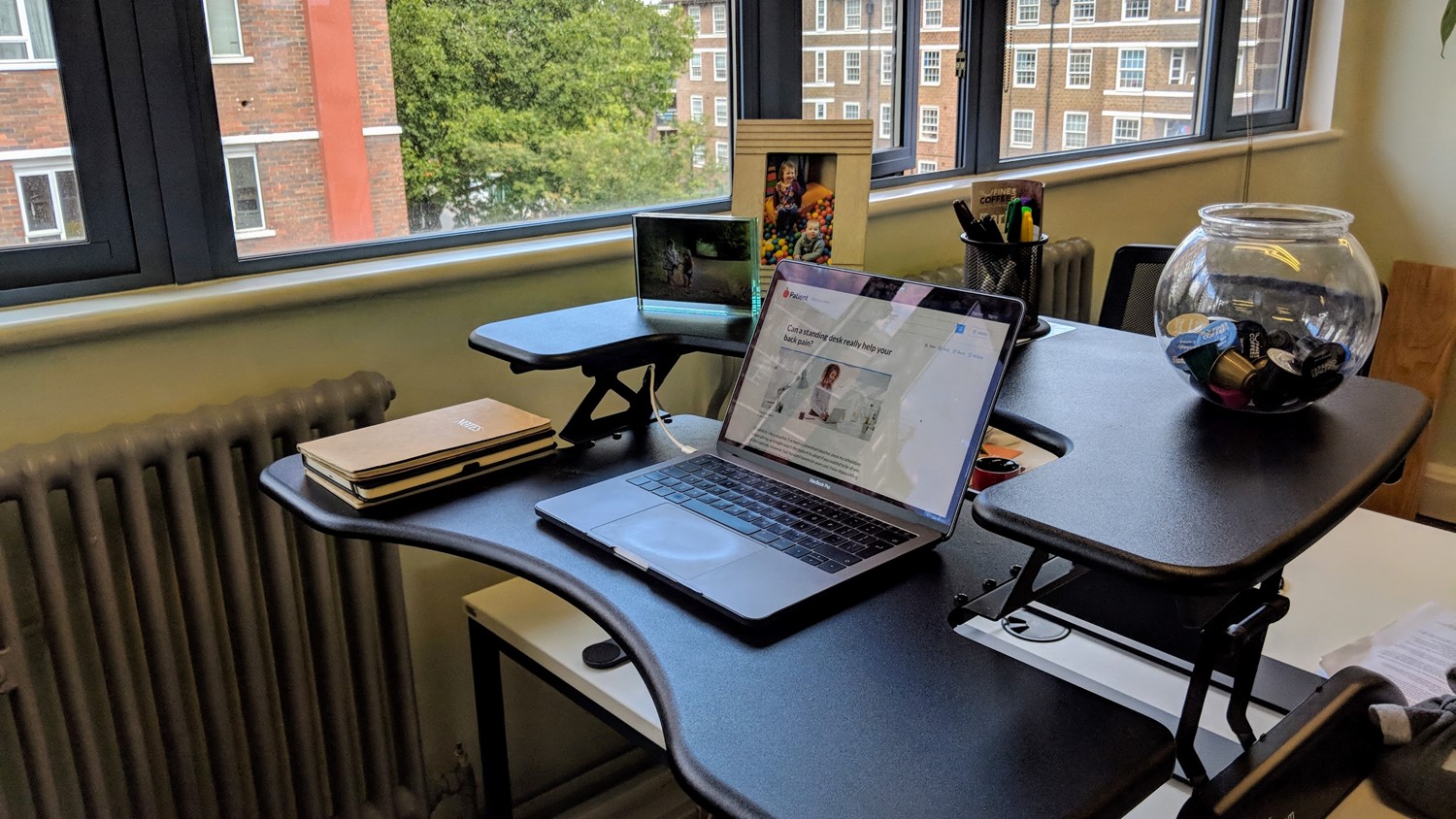
My new toy however was a regular model - a height-adjustable platform with plenty of room for all my tech, notepads, coffee cups and family photos.
The transition was an easy one to make, and one that felt immediately comfortable. There was a slight wobble to get used to (no more bashing my fists on the keyboard) but the main thing to acclimatise to was what to do with my feet. I hadn't opted for the various rolling and rocking floor accessories, but found the odd wriggle and shake enough to prevent deep vein thrombosis setting in.
Back to the future
It's been 16 weeks since I pushed my chair away for the last time. And I can categorically state that there's been a vast improvement in my pain levels.
Admittedly this is all very anecdotal, but I'm no longer reaching around to rub my lower back every five minutes.
I spoke to Nadine Foster, president of the Society for Back Pain Research in the UK to see if there was a correlation to my newfound flexibility. "To my knowledge there is no evidence that standing desks improve back pain, in terms of research to date. But they are likely to have more global benefits in terms of slightly higher energy expenditure and reducing the negative consequences of prolonged sitting."
That's definitely not a no!
Jarvis is more positive still. "I have so many patients with back pain and other health problems linked to prolonged sitting that I always keep an eye out for studies looking at sit-stand workstations and standing desks. There's good evidence that they improve risk factors for heart disease and stroke in as little as eight weeks, improve back pain among chronic pain sufferers, help with neck and upper back pain and even help your mood."
Data from backcare.org.uk suggests that we're way behind our European cousins in adopting this work stance. 80% of Scandinavian workers sit-stand at work, compared to only 1% of UK workers. Reducing your daily sitting by just one hour can burn 1 kg of fat per month. This may be one reason why our adult obesity rates are approximately 8% higher than those of Sweden, Denmark, Finland and Norway.
Tackling the status quo
Why should your workplace foot the bill for a standing desk when all your other colleagues are happy enough with a table and chair?
Back pain is the UK's most common pain complaint, with an estimated 2.5 million people suffering from back pain every day. The National Institute for Health and Care Excellence (NICE) suggests over £1 billion per year is spent on treating the condition.
Behind stress, back pain is the most common cause of workplace absence, responsible for around 5.6 million working days lost each year in the UK. That's obviously more prevalent in some industries than it is in others, but any organisation that cares about employee welfare will find that statistic a worrying one.
While there are some beautifully crafted standing desk models on the market, it doesn't have to cost your company a small fortune to get everyone up on their feet. There are plenty of cardboard-based options for less than the cost of a half-hour massage.
NHS England has listed injections for back pain on an initial list of 17 operations to be discontinued (or highly restricted), taking the view that most instances get better without treatment. Now more than ever is the time to take preventative measures to look after your back.
The getbritainstanding.org campaign recently enlisted 2 million office workers for their On Your Feet event, showing that the standing revolution is well and truly here. If my back is anything to go by, it's a movement we should all get behind.
Patient picks for Back pain

Bones, joints and muscles
When to worry about back pain
Four in five of us have back pain at some point, most commonly in our lower backs (lumbar area) or our necks. Even if the pain is severe, there's a 90% chance it'll be gone, or be much better, within six weeks. Most pain settles within a week. In 95% of cases there's no serious underlying cause - but that doesn't mean it doesn't hurt.
by Lynn Stephen

Bones, joints and muscles
The best exercises for back pain
Back pain affects nearly everyone at some point in their life. Whether it's due to a work-related injury or a fall, back pain - specifically in your lower back - causes more disability than any other condition according the World Health Organization (WHO). Yet despite how debilitating back pain can be, the good news is, there are ways to ease some of this pain and get you back to feeling like yourself again.
by Lynn Stephen
About the author
Authored by

Danny Chadburn
Head of Content
Danny was the previous Head of Content at Patient.
About the reviewerView full bio

Dr Sarah Jarvis
Clinical Consultant
MA (Cantab), BM, BCh (Oxon), DRCOG, FRCGP, MBE
After training in medicine at Cambridge and Oxford, Dr Sarah Jarvis MBE became a GP.
Join the conversation
Share your thoughts or experiences with others in our patient communities.

Ask, share, connect.
Browse discussions, ask questions, and share experiences across hundreds of health topics.

Feeling unwell?
Assess your symptoms online for free
Sign up to the Patient newsletter
Your weekly dose of clear, trustworthy health advice - written to help you feel informed, confident and in control.
By subscribing you accept our Privacy Policy. You can unsubscribe at any time. We never sell your data.