Pilar cysts
Epidermoid and sebaceous cysts
Peer reviewed by Dr Toni Hazell, FRCGPLast updated by Dr Philippa Vincent, MRCGPLast updated 20 Nov 2021
Meets Patient’s editorial guidelines
- DownloadDownload
- Share
- Language
- Discussion
- Audio Version
- Add to preferred sources on Google
Medical Professionals
Professional Reference articles are designed for health professionals to use. They are written by UK doctors and based on research evidence, UK and European Guidelines. You may find the Epidermoid and pilar cysts article more useful, or one of our other health articles.
What are epidermoid and pilar cysts?
Epidermoid or pilar cysts are very common and are usually of no clinical significance.
Epidermoid cysts (also known as epithelial, epidermal or sebaceous cysts) are intradermal or subcutaneous tumours. Epidermoid cysts may occur anywhere on the body but occur most often on the face, scalp, neck, back and scrotum. Although they are most commonly known as sebaceous cysts, they actually do not involve the sebaceous gland.1
Pilar cysts (also called trichilemmal cysts) are clinically indistinguishable from epidermal cysts. They contain keratinous material, are often multiple and there may be an autosomal dominant inheritance.2
Who gets epidermoid and pilar cysts? (Epidemiology)2
Pilar cysts and epidermoid cysts are most common types of skin cyst.
They are usually sporadic but can occur as part of an autosomal dominant trait.
They are more common in women than men.
They are very slow growing.
Epidermoid cysts are also usually sporadic but can occur as part of an autosomal dominant trait.
They tend to occur between the ages of 20 and 40 and are twice as common in men than women.
Babies often develop tiny epidermoid cysts, which spontaneously resolve, called milia, colloquially known as "baby acne" or "milk spots" (though neither of these names is accurate).
Up to 1% of epidermoid cysts have been shown to transform to squamous cell carcinoma or basal cell carcinoma.
Immunosuppressants such as imiquimod and cyclosporine have been shown to cause epidermoid cysts.
Epidermoid cyst on the neck
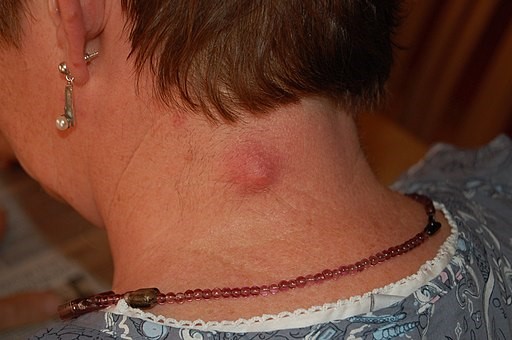
© Steven Fruitsmaak (Own work) - close-up view, CC BY-SA 3.0, via Wikimedia Commons
Epidermoid and pilar cyst symptoms
Most often they present as a painless skin lump.
They may present with discharge of an offensive thick creamy material.
If they become infected, they are red, inflamed and painful.
Lesions of the genitals can be painful during intercourse and cause problems with walking or wearing underwear. They can also interfere with micturition.
Epidermoid and pilar cysts appear as firm, round, mobile, flesh-coloured to yellow or white subcutaneous nodules of variable size.
A central pore or punctum may tether the cyst to the overlying epidermis and a thick cheesy material can sometimes be expressed.
In people with dark skin, the cysts may also be pigmented.
Sites affected by epidermoid and pilar cysts
The sites most commonly affected are, in descending order of frequency, the face, the trunk, the neck, the extremities and the scalp.
Cysts of the genitals are less common and may appear as a mass in the vulva, the clitoris, the penis, the scrotum, or the perineum. In cultures which practise female circumcision (or female genital mutilation) cysts on the vulva are common.
The ocular and oral mucosae can also be affected and cysts have been reported on the palpebral conjunctivae, on the lips, on the buccal mucosa, on and under the tongue and even on the uvula. These are not sites with hair follicles.
Cysts may occur on the extremities. Subungual cysts can cause changes in the nails, such as onycholysis and subungual hyperkeratosis, which may be mistaken for psoriasis or onychomycosis. These cysts also produce changes in the nails (such as pincer nails) erythema, oedema, tenderness and pain.
Palmoplantar lesions represent a unique subset of epidermoid cysts.
Differential diagnosis
Other causes of skin cysts.
A lipoma tends to be larger and is very soft.
A neurofibroma is hard and may be multiple.
An abscess is hot and red and may resemble an infected sebaceous cyst.
A Merkel's cell carcinoma may look like a pilar or epidermoid cyst but occurs in older people and tends to be very fast growing.
Multiple cysts in a teenager may suggest Gardner's syndrome.
Diagnosing epidermoid and pilar cysts (investigations)
Usually the diagnosis is clear and no investigations are required. If malignancy is suspected, excision and histology are required.
Associated diseases
Epidermoid cysts are a feature of Gardner's syndrome which is an autosomal dominant condition comprising familial polyposis coli, cutaneous cysts and osteomas or other soft-tissue tumours. The cysts tend to occur at an earlier age than usual (presenting most often in the early teenage years). The face may be involved but the extremities tend to be affected more than the trunk.
Epidermoid and pilar cyst treatment
Most people with an epidermoid or pilar cyst do not need medical attention.
If a cyst is uncomplicated then no treatment is usually advised. The cyst may disappear spontaneously, leaving no trace. Even the most skilful excision will leave a permanent scar.
An infected cyst will usually require an oral antibiotic effective against staphylococci - for example, flucloxacillin. The infection may be mixed and, in lesions of the scalp and anogenital area, anaerobic flora are more likely.
If the cyst has ruptured, the contents can be expressed. However, the cyst may well re-form.
If the cyst is troublesome or if the patient, after counselling, is eager to have it removed then the entire cyst should be excised as a surgical procedure. However, this is usually not available on the NHS unless it is causing significant symptoms.
Excision of an epidermoid or pilar cyst
See also separate article Minor surgery in primary care.
The usual preliminaries of informed consent are assumed.
Information includes the warning that the cyst may recur if all the wall is not removed.
Appropriate aseptic precautions should be taken.
Local anaesthetic such as 1% lidocaine with adrenaline (epinephrine) is used (note contra-indications to use of adrenaline (epinephrine) in certain areas). The area is infiltrated with local anaesthetic, being careful not to puncture the cyst.
Make a careful and superficial incision over the cyst avoiding rupture of the cyst. Care should be taken to remove all the cyst wall if the cyst is ruptured.
Toothed forceps can be used to grip the skin - a blunt dissection of adhesions allows mobilisation of the cyst and removal. A Volkmann spoon or scissors are useful for the blunt dissection.
If the cyst is large and leaves a significant defect then a resorbable subcutaneous suture should be used to close a potential space for haematoma to form.
The diagnosis of an epidermoid or pilar cyst is usually obvious. However, excised tissue should always be submitted for histology.
Complications with epidermoid or pilar cysts
Dislike of the cosmetic appearance
Infection.
Malignant change is rare (causes rapid growth, friability and bleeding).
Prognosis
They will usually grow slowly and only need removal if causing symptoms. They tend to recur if incised rather than excised.
Exclusive updates for healthcare professionals
Stay informed with the latest clinical updates, professional insights, and evidence-based guidance. The Patient Pro newsletter curates essential content for healthcare professionals—delivered straight to your inbox.
By subscribing you accept our Privacy Policy. You can unsubscribe at any time. We never sell your data.
Further reading and references
- Al Aboud DM, Yarrarapu SNS, Patel BC; Pilar Cyst. StatPearls, August 2021.
- Trichilemmal cyst; DermNet NZ.
- Pilar cyst; Primary Care Dermatology Society.
- Zito PM, Scharf R; Epidermoid Cyst.
- Al Aboud DM, Yarrarapu SNS, Patel BC; Pilar Cyst.
About the authorView full bio

Dr Philippa Vincent, MRCGP
General Practitioner, Medical Author
MB BS, Bsc, MRCGP (2000), DCH, DFSRH, DRCOG
Dr Philippa Vincent is an NHS GP working in North London.
About the reviewerView full bio

Dr Toni Hazell, FRCGP
MBBS, BSc, FRCGP, DFSRH, Dip GU med, DRCOG, DCH (London, UK, 2000)
Dr. Toni Hazell qualified from St. Mary’s Hospital Medical School and did her VTS at Northwick Park Hospital.
Article history
Article also available in English, German, Spanish, French, Italian, Portuguese, Hindi, Hebrew, Arabic, and Swedish.
Next review due: 19 Nov 2026
20 Nov 2021 | Latest version

Ask, share, connect.
Browse discussions, ask questions, and share experiences across hundreds of health topics.

Feeling unwell?
Assess your symptoms online for free
More in dermatology
- Allergic phenomena
- Alopecia
- Asteatotic eczema
- Atopic dermatitis and eczema
- Blind treatment of bacterial infection
- Discoid lupus erythematosus
- Drug allergy
- Hereditary angio-oedema
- Lipoma
- Localised scleroderma
- Malignant melanoma
- Melasma
- Necrotising fasciitis
- Pathogenic free-living amoeba
- Perioral dermatitis
- Psoriatic arthritis
- Skin and subcutaneous nodules
- Urticaria
- Varicose eczema