Knee and kneecap pain
Patellofemoral pain syndrome
Peer reviewed by Dr Surangi Mendis, MRCGPLast updated by Dr Rachel Hudson, MRCGPLast updated 31 Oct 2023
Meets Patient’s editorial guidelines
- DownloadDownload
- Share
- Language
- Discussion
- Audio Version
- Add to preferred sources on Google
Most knee conditions cause pain in the front (anterior) of the knee. Patellofemoral pain is the name given to this. Pain at the back of the knee is usually caused by a Baker's cyst (also known as a popliteal cyst). The rest of this leaflet deals with patellofemoral pain syndrome, which is much more common.
At a glance
Patellofemoral pain syndrome causes pain at the front of the knee, around the kneecap.
It is often worse when going up or down stairs, running, or after long periods of sitting.
It is thought to be due to increased pressure between the kneecap and thighbone.
Treatment includes avoiding strenuous use of the knee, painkillers, and physiotherapy.
Surgery is not usually the first treatment choice.
What is patellofemoral pain syndrome?
Patellofemoral pain syndrome is the medical term used when pain occurs at the front of the knee, around the kneecap (patella), without signs of any damage or other problems in the knee joint.
Patellofemoral pain syndrome may also be referred to as anterior knee pain, or runner's knee.
Knee cross-section with patella
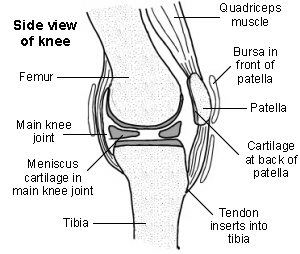
The patella is the kneecap bone. It lies within the quadriceps tendon. This large tendon from the powerful thigh muscles (quadriceps) wraps round the patella and is attached to the top of the lower leg bone (tibia). The quadriceps muscles straighten the knee.
The back of the patella is covered with smooth cartilage. This helps the patella to glide smoothly over the lower part of the thighbone (femur) when you straighten your leg.
Patellofemoral pain is a general term used for pain in the front (anterior) of the knee. However, you might also see some terms referring to specific conditions causing anterior knee pain. These include:
Other causes of knee pain can include:
Knee cartilage injuries (meniscal tears).
Gout.
Knee pain can also be caused by hip problems.
Patellofemoral pain syndrome symptoms
Symptoms of patellofemoral pain syndrome include:
Pain around the knee. The pain is felt at the front of the knee, around or behind the kneecap (patella). Often, the exact site of the pain cannot be pinpointed; instead the pain is felt vaguely at the front of the knee.
The pain comes and goes.
Both knees are often affected at the same time but one is usually worse than the other.
The pain is typically worse when going up or, in particular, going down stairs.
Running, especially downhill, squatting and certain sports can all set it off - anything that leads to the patella being compressed against the lower part of the thighbone.
The pain may be brought on by sitting still for long periods. For example, after going to the cinema or for a long drive, when it will be worse when starting to move about again.
There may be a grating or grinding feeling, or sounds in your knee when it bends and straightens. This is called crepitus. There may also be a clicking feel or sound.
Sometimes there is puffiness or swelling around the kneecap.
The range of motion of the knee is usually normal.
What causes patellofemoral pain syndrome?
It is probably due to a combination of different factors which increase the pressure between the kneecap (patella) and the lower part of the thighbone (femur). This may happen during running, cycling, squatting and going up and down stairs. It is likely that the cause is not the same in everyone affected.
Situations where this can occur include:
Overuse of the knee, such as in certain sports - particularly at times of increased training.
Cycling when the saddle is too low or too far forward.
Some people may have a slight problem in the alignment of the patella where it moves over the lower femur. This may cause the patella to rub on, rather than glide over, the lower femur (this is known as maltracking). It may be due to the way the knee has developed. Or, it may be due to an imbalance in the muscles around the knee and hip - for example, the large quadriceps muscle above the knee and the muscles that stop the hips from tilting when standing on one leg.
Weak hip muscles may cause patellofemoral pain by causing the thighbone to be slightly turned inwards, leading to the patella being pulled slightly to one side.
Foot problems may also play a part - for example, where the feet do not have strong arches (flat feet). This makes the foot roll inwards (pronate), which means the knee has to compensate for the inward movement. However, it is unclear whether this causes the knee problems or may be caused by the knee problems.
Injury to the knee - including repeated small injuries or stresses due to sports, or due to slack ligaments (hypermobile joints).
Having obesity or being overweight, and wearing unsupportive footwear may also contribute to patellofemoral pain.
A combination of an alignment problem (see above) and overuse in sport is thought to be the most common reason for having patellofemoral pain.
How is patellofemoral pain syndrome diagnosed?
The diagnosis is made from your symptoms, the history of the problem, plus a physical examination of your knee.
Tests, such as X-rays or scans, cannot diagnose patellofemoral pain and are often not helpful. However, sometimes they might need to be done to diagnose maltracking or look for other conditions.
If knee pain persists despite treatment, you may wonder whether further investigation or a scan is needed. Find out more about when persistent knee pain may need a scan.
Patellofemoral pain syndrome treatment
In the short term
Avoid strenuous use of the knee - until the pain eases. Symptoms usually improve in time if the knee is not overused. Aim to keep fit but to reduce the activities which cause the pain.
Painkillers - paracetamol and/or anti-inflammatory painkillers such as ibuprofen.
Physiotherapy:
Improving the strength of the muscles around the knee and hip will ease the stress on the knee.
Specific exercises may help to correct problems with alignment and muscle balance around the knee. For example, you may be taught to do exercises which strengthen the muscles of the hip and buttock.
The physiotherapist can give advice tailored to your individual situation.
Taping of the kneecap (patella) - this is a treatment which may reduce pain, but doesn't appear to have any long-term benefits. It involves adhesive tape being applied over the patella, to alter the alignment or the way the patella moves. Some people find this helpful. Some physiotherapists can offer patellar taping treatment.
In the longer term
Treatment aims to treat some of the underlying causes - for example, by strengthening hip muscles and helping with foot problems:
Physiotherapy - a long-term home exercise programme, for at least one year.
Suitable footwear - for example, arch supports if you have flat feet; suitable shoes if you are running.
Losing weight if your weight is above the recommend weight for your height is likely to help reduce pain.
Surgery is no longer recommended as first-line treatment for patellofemoral syndrome as the evidence suggests that most people do just as well - if not better - with non-surgical (conservative) treatment. However, surgery is still occasionally considered for people with anterior knee pain who do not respond to conservative treatment, depending on the diagnosis.
What is the outlook?
The outlook (prognosis) was thought to be good and that most people got better after 4-6 months with simple treatments such as physiotherapy. However, recent studies suggest that over 50% of people still report pain and difficulties with their knee 5-8 years after physiotherapy treatment. Ongoing research is looking into how this picture can be improved.
Patient picks for Knee pain

Bones, joints and muscles
Baker's cyst
A Baker's cyst is a swelling that can develop behind the knee. It is filled with the lubricating fluid that is usually found inside the knee joint, known as "synovial fluid". It most commonly occurs if there is an underlying problem with the knee such as osteoarthritis. Symptoms can include pain, swelling and tightness behind the knee. Sometimes, a Baker's cyst can split open (rupture) and cause symptoms in the calf that can be similar to a deep vein thrombosis (DVT). A Baker's cyst often gets better and disappears by itself over time. However, there are various treatments that may help if there are symptoms associated with it.
by Dr Philippa Vincent, MRCGP

Bones, joints and muscles
Housemaid's knee
Housemaid's knee is also known as prepatellar bursitis. It is caused by inflammation of a small fluid-filled sac (the bursa) in front of the kneecap. It more commonly occurs in people who spend long periods of time kneeling. Treatment is usually supportive and the outlook is generally very good.
by Dr Colin Tidy, MRCGP
Frequently asked questions
What is the difference between patellofemoral pain syndrome and other types of knee pain?
Patellofemoral pain syndrome specifically refers to pain at the front of the knee, around the kneecap, without any signs of damage or other problems within the knee joint itself. Other conditions like chondromalacia patellae, housemaid's knee, or Osgood-Schlatter disease are specific types of anterior knee pain. Separately, general knee pain can stem from issues like ligament sprains, cartilage injuries, various forms of arthritis, or even hip problems, which are distinct from patellofemoral pain syndrome.
If my knee clicks or grinds, does it mean I have patellofemoral pain syndrome?
A grating, grinding feeling, or sounds (crepitus) in your knee when it bends and straightens, as well as clicking sounds, can be a symptom of patellofemoral pain syndrome. However, these sounds alone are not enough for a diagnosis. They are part of a broader set of symptoms that, combined with a physical examination and history of the problem, can lead to a diagnosis of patellofemoral pain syndrome.
Can cycling contribute to patellofemoral pain syndrome?
Yes, cycling can contribute to patellofemoral pain syndrome, especially if the bicycle saddle is positioned too low or too far forward. This can increase the pressure between the kneecap and the thighbone, leading to pain. Adjusting your bike setup might help alleviate this issue.
Do I need an X-ray or scan to diagnose patellofemoral pain syndrome?
No, X-rays or scans cannot typically diagnose patellofemoral pain syndrome and are often not helpful for this specific condition. The diagnosis is usually made based on your symptoms, the history of your knee problem, and a physical examination of your knee. However, these tests might sometimes be used to diagnose other conditions or to investigate possible maltracking of the kneecap.
Will physiotherapy completely cure my patellofemoral pain syndrome?
Physiotherapy is a key treatment for patellofemoral pain syndrome, focusing on strengthening muscles around the knee and hip, and correcting alignment issues. While it offers significant relief and is the recommended first-line treatment, recent studies suggest that over 50% of people still report some pain and difficulties years after physiotherapy. Ongoing research aims to improve these long-term outcomes.
Is surgery an option for patellofemoral pain syndrome?
Surgery is generally not recommended as the first-line treatment for patellofemoral pain syndrome. Evidence suggests that conservative treatments, such as physiotherapy, are often as effective, if not more so. However, surgery may occasionally be considered for individuals whose anterior knee pain does not improve with conservative treatments, depending on their specific diagnosis.
Further reading and references
- Smith BE, Selfe J, Thacker D, et al; Incidence and prevalence of patellofemoral pain: A systematic review and meta-analysis. PLoS One. 2018 Jan 11;13(1):e0190892. doi: 10.1371/journal.pone.0190892. eCollection 2018.
- Crossley KM, Stefanik JJ, Selfe J, et al; 2016 Patellofemoral pain consensus statement from the 4th International Patellofemoral Pain Research Retreat, Manchester. Part 1: Terminology, definitions, clinical examination, natural history, patellofemoral osteoarthritis and patient-reported outcome measures. Br J Sports Med. 2016 Jul;50(14):839-43. doi: 10.1136/bjsports-2016-096384. Epub 2016 Jun 24.
- McClinton SM, Cobian DG, Heiderscheit BC; Physical Therapist Management of Anterior Knee Pain. Curr Rev Musculoskelet Med. 2020 Dec;13(6):776-787. doi: 10.1007/s12178-020-09678-0. Epub 2020 Oct 30.
- Gaitonde DY, Ericksen A, Robbins RC; Patellofemoral Pain Syndrome. Am Fam Physician. 2019 Jan 15;99(2):88-94.
- Anterior knee pain (patellofemoral dysfunction): physiotherapy exercises; Royal Berkshire NHS Foundation Trust, February 2022
About the authorView full bio

Dr Rachel Hudson, MRCGP
General Practitioner and Medical Author
MBChB, MRCGP (2008), BSc (Medical Science), DFSRH, DRCOG, DCH
Dr Rachel Hudson, is an NHS GP working in the North West of England.
About the reviewerView full bio

Dr Surangi Mendis, MRCGP
Consultant and Medical Author
MBBS, BSc (1st), MRCGP (2014), DFSRH, PGcert otology and audiology
Surangi Mendis is a consultant in Audiovestibular Medicine and Neuro-otology at The Royal National ENT and Eastman Dental Hospitals, UCLH.
Article history
The information on this page is written and peer reviewed by qualified clinicians.
Article also available in English, German, Spanish, French, Italian, Portuguese, Hindi, Hebrew, Arabic, and Swedish.
Next review due: 29 Oct 2028
31 Oct 2023 | Latest version
Join the conversation
Share your thoughts or experiences with others in our patient communities.

Ask, share, connect.
Browse discussions, ask questions, and share experiences across hundreds of health topics.

Feeling unwell?
Assess your symptoms online for free
Sign up to the Patient newsletter
Your weekly dose of clear, trustworthy health advice - written to help you feel informed, confident and in control.
By subscribing you accept our Privacy Policy. You can unsubscribe at any time. We never sell your data.
More in bones, joints and muscles
- Axial spondyloarthritis
- Back pain in children
- Broken or bruised ribs
- Disease-modifying antirheumatic drugs
- Dupuytren's contracture
- Ganglion
- Gout
- Greater trochanteric pain syndrome
- Hip replacement
- Housemaid's knee
- Lower back pain
- Lupus
- Metatarsal fractures
- Myasthenia gravis
- Osteoporosis
- Rhabdomyosarcoma
- Rheumatoid arthritis
- Spinal anaesthetic
- Spinal stenosis
- Torticollis