Chikungunya fever
Peer reviewed by Dr Krishna Vakharia, MRCGPLast updated by Dr Hayley Willacy, FRCGP Last updated 21 Aug 2023
Meets Patient’s editorial guidelines
- DownloadDownload
- Share
- Language
- Discussion
- Audio Version
- Add to preferred sources on Google
Chikungunya fever is an illness caused by a virus. The virus infects you when you are bitten by a certain type of mosquito. You cannot catch chikungunya fever in the UK but you may be at risk of catching it when abroad.
It usually causes a high temperature (the 'fever') and joint pains. In most people it goes away completely after one or two weeks. In a few people it may be a more serious illness. There is no specific treatment.
Before travelling, always check the Travel advice by country page to get the latest information on infections in the area to which you are going. Chikungunya can be prevented by taking measures to avoid mosquito bites.
At a glance
Chikungunya is a viral illness spread by mosquito bites, mainly in warmer parts of the world.
Symptoms typically start 4-8 days after a bite and include fever and severe joint pain.
Other symptoms can include tiredness, rash, muscle pains, and headache.
Most people recover in one to two weeks, but joint pain can last longer for some.
There is no vaccine or specific treatment; paracetamol or ibuprofen can help with symptoms.
If travelling to affected areas, use insect repellent and wear protective clothing to prevent bites.
Seek medical advice if you develop symptoms during or after travel.
What is chikungunya?
Chikungunya (or chikungunya fever) is an illness caused by a virus. The virus gets into your system when you are bitten by a particular type of mosquito. The type of mosquito which transmits the chikungunya virus is called an Aedes mosquito. These mosquitoes tend to bite in the daytime rather than at night.
The mosquito carries the virus after biting another person or animal who has the chikungunya infection. The virus multiplies in your bloodstream, causing you to become unwell usually 4-8 days after the mosquito bite. The virus causes you to develop a temperature and joint pains. There may be other symptoms.
What causes chikungunya?
Anyone bitten by a mosquito infected with the chikungunya virus, can get the illness. It only occurs in certain parts of the world. It only occurs in countries where it is warm enough for the mosquito to survive.
It is not warm enough for this type of mosquito in the UK, so you cannot get the infection in the UK. However, if you travel to a country where there is an outbreak of chikungunya fever, you may become infected if you are bitten by an infected mosquito.
Up until 2013, chikungunya fever was mainly a risk only in certain parts of Africa and Asia. In 2013, however, cases were reported in the Caribbean and in North and South America. Since then there have been outbreaks across the Caribbean and the Americas, with many thousands of people catching the virus.
Who gets chikungunya?
Anybody at any age can get chikungunya fever. However, it tends to be more severe in certain groups of people. This includes:
Newborn babies and very young children.
People aged over 65 years.
People with other medical conditions.
Is chikungunya contagious?
Chikungunya is not contagious; that is, you cannot catch chikungunya fever from another person. It is only passed on if you are bitten by a mosquito which has bitten another person or animal infected with the virus.
The exception to this is that newborn babies have been known to develop chikungunya fever shortly after birth if their mother has the infection. Infection with chikungunya fever during pregnancy may also result in infection and problems for the developing baby.
How common is chikungunya?
How common chikungunya is varies because it tends to occur in outbreaks. Since being first reported in the Caribbean and the Americas, there have been more than 1.2 million cases in these regions.
In the UK it is very rare. There were 295 cases reported in 2014 in England, Wales and Northern Ireland. All these illnesses happened in people who had travelled abroad. Most of them had been to the Caribbean or South America.
In 2016 the countries reporting most cases were Brazil (265,000 suspected cases), Bolivia and Colombia (19,000 suspected cases, respectively). In the African region, Kenya reported an outbreak of chikungunya resulting in more than 1,700 suspected cases. In 2017, Pakistan continued to respond to an outbreak which started in 2016.
What are chikungunya symptoms?
The symptoms of the illness usually start four to eight days after the person has been bitten by the infected mosquito. It starts with a high temperature (fever) and joint pains. The joint pains may be very severe.
The word 'chikungunya' comes from an African word which means 'that which bends up'. This is because people with the illness may be bent over in pain. Any joint can be affected but most commonly the joints of the hands, wrists and ankles are painful.
Other symptoms which may be present include:
Feeling tired.
Feeling sick.
A rash.
Muscle pains.
A headache.
Chikungunya rash
Chikungunya fever rash
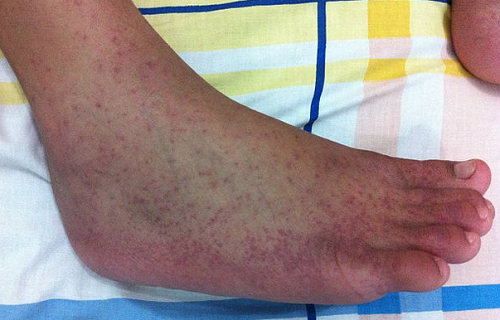
Usually the symptoms last one or two weeks, and then completely settle. In a few people, however, the joint pains can carry on for weeks or months after the infection has gone.
Very rarely more serious symptoms occur. These are more likely in more vulnerable people. For example, young babies, the elderly or people with other medical conditions may be more prone to the more serious symptoms. These more unusual complications include:
Pains in the eye or loss of vision.
Fits (seizures).
Drowsiness.
Infections in parts of the brain (meningitis or encephalitis).
Watery stools (diarrhoea).
Breathing problems.
Heart problems.
Kidney problems.
Liver infection.
Are there any tests for chikungunya fever?
A blood test can be taken to confirm chikungunya. In the UK it has to be sent to a special laboratory for rare imported diseases. The blood sample can be checked to see if the virus can be found. It may also be checked for antibodies which are produced by your immune system to fight the virus.
What is the treatment for chikungunya?
There is no specific medication which tackles the virus itself. Normally you will be advised to take medicines such as paracetamol or ibuprofen to help with the joint pains and high temperature (fever). You will be advised to drink plenty of fluid. People who become very unwell may need to have extra care in hospital.
What is the usual outcome?
Most people make a full recovery within one to two weeks. Some people may be left with joint pains which can go on for weeks or months.
A very few people have complications (see the 'symptoms' section above). It is rare to die from chikungunya fever but it can happen occasionally.
How to prevent chikungunya fever - Advice for UK travellers
If travelling to an area where chikungunya fever occurs, take all possible precautions to avoid being bitten by a mosquito. For example:
Use insect repellent. Those containing a chemical called N, N-diethylmetatoluamide (DEET) are known to be the most effective. Apply insect repellent regularly and re-apply after swimming. If also using sunscreen, apply the insect repellent after the sunscreen.
Sleep in rooms with mosquito screens and/or mosquito nets.
The use of mosquito coils may be helpful outside.
Wear clothing that protects you from bites - ie long sleeves and long trousers. For areas affected by chikungunya fever, you need this type of clothing even in the daytime. This is because the Aedes mosquitoes tend to bite in the daytime, unlike other types which usually bite in the evenings. There are some insecticides available which can be sprayed on to clothing.
There is no vaccine available to prevent chikungunya infection.
If you develop a high temperature or joint pains while abroad, or shortly after you return, seek medical advice.
The risk areas are constantly changing and evolving, and travellers should check the latest information on our Travel advice by country page before they travel.
Patient picks for Travel related infections
Travel and vaccinations
Malaria prevention
It is sensible to find out whether there is a risk of malaria in the place you are visiting. If there is a risk, you can avoid getting malaria by taking steps to avoid mosquito bites, and in some cases by taking antimalarial medication. Malaria can be a life-threatening illness, so it is extremely important to consider prevention before travelling to an at-risk area.
by Dr Hayley Willacy, FRCGP

Travel and vaccinations
Dengue
Dengue (which used to be called dengue fever) is a viral illness which is very common in the tropics and subtropics. It is usually a flu-like illness lasting under a week but it can sometimes be very serious, even fatal.
by Dr Philippa Vincent, MRCGP
Frequently asked questions
Can chikungunya affect animals too?
Yes, the Aedes mosquito carries the chikungunya virus after biting another person or animal who has the infection.
Is it safe to travel when pregnant if there's a chikungunya outbreak?
Infection with chikungunya fever during pregnancy may result in infection and problems for the developing baby. This suggests caution is warranted, and travellers should check the latest information on our Travel advice by country page before they travel.
What is the typical incubation period for chikungunya?
The virus usually causes you to become unwell 4-8 days after the mosquito bite. The symptoms of the illness usually start within this timeframe after being bitten by an infected mosquito.
Can I get chikungunya more than once?
The article does not explicitly state whether a person can get chikungunya more than once.
Are there any specific pain relievers that are better for chikungunya symptoms?
Normally, you will be advised to take medicines such as paracetamol or ibuprofen to help with the joint pains and high temperature (fever).
Will I automatically get a rash if I have chikungunya?
A rash is listed as one of the symptoms that may be present, but it's not stated that everyone with chikungunya will develop one.
What should I do if I think I have chikungunya after returning to the UK?
If you develop a high temperature or joint pains shortly after you return from an area where chikungunya fever occurs, you should seek medical advice.
Further reading and references
- Chikungunya; World Health Organization
- Chikungunya Fever; Public Health England
- Chikungunya; Travel Health Pro.
- Bauer IL; The oral repellent - science fiction or common sense? Insects, vector-borne diseases, failing strategies, and a bold proposition. Trop Dis Travel Med Vaccines. 2023 Jun 28;9(1):7. doi: 10.1186/s40794-023-00195-9.
- Ojeda Rodriguez JA, Haftel A, Walker, III JR; Chikungunya Fever.
About the authorView full bio
Updated by

Dr Hayley Willacy, FRCGP
General Practitioner, Medical Author
MBChB (1992), DRCOG, DFFP, MRCOG (Part 1) MRCGP (2007), DFSRH (2013), MSc - medical education (2020)
Dr Hayley Willacy was an NHS GP working in northwest England, who retired from clinical practice in 2022 after 30 years.
About the reviewerView full bio

Dr Krishna Vakharia, MRCGP
Chief Medical Officer for Health, Optum UK
MBChB, MRCGP(2013), BMedSci (hons), DFSRH, DRCOG, PGDipDerm (Distn)
Dr Krishna Vakharia is an NHS GP. She is also a regular examiner for the postgraduate Diploma in Practical Dermatology at Cardiff University as well as being the Chief Medical Officer for health at Optum UK.
Join the conversation
Share your thoughts or experiences with others in our patient communities.

Ask, share, connect.
Browse discussions, ask questions, and share experiences across hundreds of health topics.

Feeling unwell?
Assess your symptoms online for free
Sign up to the Patient newsletter
Your weekly dose of clear, trustworthy health advice - written to help you feel informed, confident and in control.
By subscribing you accept our Privacy Policy. You can unsubscribe at any time. We never sell your data.